Link Copied!
Iamblichus Quotes (245-325)
Philosopher




About Iamblichus
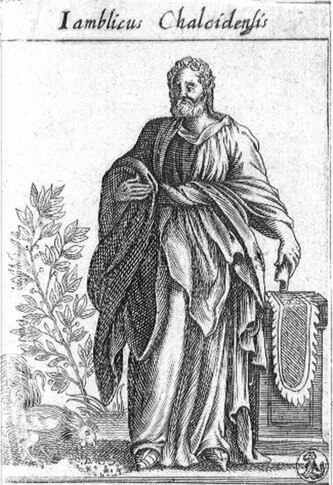
Iamblichus of Chalcis or Iamblichus Chalcidensis (Ἰάμβλιχος; c. 245 – c. 325) was a Greek Neoplatonic philosopher from Syria who heavily influenced later Neoplatonism, and much of western pagan philosophy. He is most famous for his compendium on Pythagorean philosophy.
Best Iamblichus Quotes
Shortest
Earliest
Explore our curated collection of the most famous and impactful Iamblichus quotes.
“It is irreverent to the Gods to give you this demonstration, but for your sakes it shall be done.”

“This also is a beautiful circumstance, that they referred every thing to Pythagoras, and called it by his name, and that they did not ascribe to themselves the glory of their own inventions, except very rarely.”
“They call it "friendship" and "peace," and further "harmony" and "unanimity": for these are all cohesive and unificatory of opposites and dissimilars. Hence they also call it "marriage." And there are also three ages in life.”
“It is necessary that every man be surpassingly temperate. That person would most of all be a man of this sort if he were superior to money, which is what corrupts all men, and if, without caring about his life, he bestowed his pains on things that are just and pursued virtue.”

“No one will deny that the soul of Pythagoras was sent to mankind from Apollo's domain, having either been one of his attendants, or more intimate associates, which may be inferred both from his birth, and his versatile wisdom.”
“If the potential of every number is in the monad, then the monad would be intelligible number in the strict sense, since it is not yet manifesting anything actual, but everything conceptually together in it.”

“Furthermore, the monad produces itself and is produced from itself, since it is self-sufficient and has no power set over it and is everlasting; and it is evidently the cause of permanence, just as God is thought to be in the case of actual physical things, and to be the preserver and maintainer of natures.”
“They also gave it the title of "opinion," because truth and falsity lie in opinion. And they called it "movement," "generation," "change," "division," "length," "multiplication," "addition," "kinship," "relativity," "the ratio in proportionality." For the relation of two numbers is of every conceivable form.”

“The Pythagoreans thought those who teach for the sake of reward show themselves worse than sculptors, or artists who perform the work sitting. For these, when someone orders wood to make a statue of Hermes, search for wood suited to receive the proper form; while those pretend that they can readily produce the works of virtue from every nature.”

“What appears to us to be an accurate definition of justice does not also appear to be so to the Gods. For we, looking to that which is most brief, direct our attention to things present, and to this momentary life, and the manner in which it subsists. But the Powers that are superior to us know the whole life of the Soul, and all its former lives.”

“Just as without the monad there is in general no composition of anything, so also without it there is no knowledge of anything whatsoever, since it is a pure light, most authoritative over everything in general, and it is sun-like and ruling, so that in each of these respects it resembles God, and especially because it has the power of making things cohere and combine, even when they are composed of many ingredients and are very different from one another, just as he made this universe harmonious and unified out of things which are likewise opposed.”
“Hence the Pythagoreans in their theology called it sometimes "universe," sometimes "heaven," sometimes "all," sometimes "Fate" and "eternity," "power" and "trust" and "Necessity," "Atlas" and "unwearying," and simply "God" and "Phanes" and "sun."
They called it "universe," because all things are arranged by it both in general and in particular, and because it is the most perfect boundary of number, in the sense that "decad" is, as it were, "receptacle," just as heaven is the receptacle of all things, they called it "heaven" and, among the Muses, "Ourania."”
They called it "universe," because all things are arranged by it both in general and in particular, and because it is the most perfect boundary of number, in the sense that "decad" is, as it were, "receptacle," just as heaven is the receptacle of all things, they called it "heaven" and, among the Muses, "Ourania."”
“Likewise, they call it "Chaos," which is Hesiod's first generator, because Chaos gives rise to everything else, as the monad does. It is also thought to be both "mixture" and "blending," "obscurity" and "darkness" thanks to the lack of articulation and distinction of everything which ensues from it.
Anatolius says that it is called "matrix" and "matter," on the grounds that without it there is no number.
The mark which signifies the monad is the source of all things.”
Anatolius says that it is called "matrix" and "matter," on the grounds that without it there is no number.
The mark which signifies the monad is the source of all things.”

“The Pythagoreans called the monad "intellect" because they thought that intellect was akin to the One; for among the virtues, they likened the monad to moral wisdom; for what is correct is one. And they called it "being," "cause of truth," "simple," "paradigm," "order," "concord," "what is equal among the greater and the lesser," "the mean between intensity and slackness," "moderation in plurality," "the instant now in time," and moreover they call it "ship," "chariot," "friend," "life," "happiness."”

“After his father's death, though he was still but a youth, his aspect was so venerable, and his habits so temperate that he was honored and even reverenced by elderly men, attracting the attention of all who saw and heard him speak, creating the most profound impression. That is the reason that many plausibly asserted that he was a child of the divinity. Enjoying the privilege of such a renown, of an education so thorough from infancy, and of so impressive a natural appearance he showed that he deserved all these advantages by deserving them, by the adornment of piety and discipline, by exquisite habits, by firmness of soul, and by a body duly subjected to the mandates of reason. An inimitable quiet and serenity marked all his words and actions, soaring above all laughter, emulation, contention, or any other irregularity or eccentricity; his influence at Samos was that of some beneficent divinity. His great renown, while yet a youth, reached not only men as illustrious for their wisdom as Thales at Miletus, and Bias at Prione, but also extended to the neighboring cities. He was celebrated everywhere as the "long-haired Samian," and by the multitude was given credit for being under divine inspiration.”
“Since wise people are in the habit of invoking the divinities at the beginning of any philosophic consideration, this is all the more necessary on studying that one which is justly named after the divine Pythagoras. Inasmuch as it emanated from the divinities it could not be apprehended without their inspiration and assistance. Besides, its beauty and majesty so surpasses human capacity, that it cannot be comprehended in one glance. Gradually only can some details of it be mastered when, under divine guidance we approach the subject with a quiet mind. Having therefore invoked the divine guidance, and adapted ourselves and our style to the divine circumstances, we shall acquiesce in all the suggestions that come to us. Therefore we shall not begin with any excuses for the long neglect of this sect, nor by any explanations about its having been concealed by foreign disciplines, or mystic symbols, nor insist that it has been obscured by false and spurious writings, nor make apologies for any special hindrances to its progress. For us it is sufficient that this is the will of the Gods, which all enable us to undertake tasks even more arduous than these. Having thus acknowledged our primary submission to the divinities, our secondary devotion shall be to the prince and father of this philosophy as a leader.”
Iamblichus Quotes by Topic
Find exactly what you are looking for by browsing this categorized list of Iamblichus quotes by topic.
Iamblichus on Pythagoreanism 2 quotes
“Those who dwelt in the common auditorium adopted this oath: "I swear by the discoverer of the Tetraktys, which is the spring of all our wisdom; The perennial fount and root of Nature."”

Iamblichus on Arithmetic
“If the potential of every number is in the monad, then the monad would be intelligible number in the strict sense, since it is not yet manifesting anything actual, but everything conceptually together in it.”
Iamblichus on Intelligibility
“If the potential of every number is in the monad, then the monad would be intelligible number in the strict sense, since it is not yet manifesting anything actual, but everything conceptually together in it.”

Iamblichus on Tuition
“The Pythagoreans thought those who teach for the sake of reward show themselves worse than sculptors, or artists who perform the work sitting. For these, when someone orders wood to make a statue of Hermes, search for wood suited to receive the proper form; while those pretend that they can readily produce the works of virtue from every nature.”
Iamblichus on Now
“The Pythagoreans called the monad "intellect" because they thought that intellect was akin to the One; for among the virtues, they likened the monad to moral wisdom; for what is correct is one. And they called it "being," "cause of truth," "simple," "paradigm," "order," "concord," "what is equal among the greater and the lesser," "the mean between intensity and slackness," "moderation in plurality," "the instant now in time," and moreover they call it "ship," "chariot," "friend," "life," "happiness."”

What Iamblichus Said About Others
Discover personal opinions Iamblichus shared regarding contemporaries.
Iamblichus on Pythagoras 5 quotes
“Those who dwelt in the common auditorium adopted this oath: "I swear by the discoverer of the Tetraktys, which is the spring of all our wisdom; The perennial fount and root of Nature."”
Quotes About Iamblichus
Gain deeper perspective through quotes about Iamblichus from others.
H. P. Blavatsky on Iamblichus
“Scholastic skeptics, as well as ignorant materialists, have greatly amused themselves for the last two centuries over the absurdities attributed to Pythagoras by his biographer, Iamblichus. The Samian philosopher is said to have persuaded a she-bear to give up eating human flesh; to have forced a white eagle to descend to him from the clouds, and to have subdued him by stroking him gently with the hand, and by talking to him. On another occasion, Pythagoras actually persuaded an ox to renounce eating beans, by merely whispering in the animal's ear! (Iamblichus: "De Vita Pythag.") Oh, ignorance and superstition of our forefathers, how ridiculous they appear in the eyes of our enlightened generations! Let us, however, analyze this absurdity. Every day we see unlettered men, proprietors of strolling menageries, taming and completely subduing the most ferocious animals, merely by the power of their irresistible will... Every one has either witnessed or heard of the seemingly magical power of some mesmerizers and psychologists. They are able to subjugate their patients for any length of time. Regazzoni, the mesmerist who excited such wonder in France and London, has achieved far more extraordinary feats than what is above attributed to Pythagoras. Why, then, accuse the ancient biographers of such men as Pythagoras and Apollonius of Tyana of either willful misrepresentation or absurd superstition?”
Eunapius on Iamblichus
“Because he practiced justice he gained an easy access to the ears of the Gods; so much so that he had a multitude of disciples, and those who desired learning flocked to him from all parts. And it is hard to decide who among them was the most distinguished, for Sopater the Syrian was of their number, a man who was most eloquent both in his speeches and writings; and Aedesius and Eustathius from Cappadocia; while from Greece came Theodorus and Euphrasius, men of superlative virtue, and a crowd of other men not inferior in their powers of oratory, so that it seemed marvelous that he could satisfy them all; and indeed in his devotion to them all he never spared himself. Occasionally, however, he did perform certain rites alone, apart from his friends and disciples, when he worshipped the Divine Being. But for the most part he conversed with his pupils and was unexacting in his mode of life and of an ancient simplicity. As they drank their wine he used to charm those present by his conversation and filled them as with nectar. And they never ceased to desire this pleasure and never could have too much of it, so that they never gave him any peace; and they appointed the most eloquent among them to represent them, and asked: "O master, most inspired, why do you thus occupy yourself in solitude, instead of sharing with us your more perfect wisdom? Nevertheless a rumor has reached us through your slaves that when you pray to the Gods you soar aloft from the earth more than ten cubits to all appearance; that your body and your garments change to a beautiful golden hue; and presently when your prayer is ended your body becomes as it was before you prayed, and then you come down to earth and associate with us." Iamblichus was not at all inclined to laughter, but he laughed at these remarks. And he answered them thus: "He who thus deluded you was a witty fellow; but the facts are otherwise. For the future however you shall be present at all that goes on."”
Emperor Julian on Iamblichus
“I am aware that the great Plato himself, and after him, a man posterior to him in date, though not in mind, I mean Iamblichus of Chalcis (who initiated us into other branches of philosophy, and also into this by means of his discourses), did both of them as far as hypothesis goes, take for granted the fact of a Creation and assumed the universe to have been, in a certain sense, the Work of Time, in order that the most important of the effects produced by this Power, may be reduced into a shape for examination. … On the same subject you will obtain more complete and more abstruse information by consulting the works upon it composed by the divine Iamblichus: you will find there the extreme limit of human wisdom attained. May the mighty Sun grant me to attain to no less knowledge of himself, and to teach it publicly to all, and privately to such as are worthy to receive it: and as long as the god grants this to us, let us consult in common his well-beloved Iamblichus; out of whose abundance a few things, that have come into my mind, I have here set down. That no other person will treat of this subject more perfectly than he has done, I am well aware; not even though he should expend much additional labour in making new discoveries in the research; for in all probability he will go astray from the most correct conception of the nature of the god.”
Henry Osborn Taylor on Iamblichus
“Less elusive than Plato's was the supra-rationality of his distant disciple, the Egyptian Plotinus (died 270), creator of Neo-Platonism. With him the supra-rational represented an élan, a reaching beyond the clearly seen or clearly known, to the Spirit itself. He had a disciple Porphyry, like himself a sage—and yet a different sage [whose] supra-rationalities hungered for many things from which his rational nature turned askance. But he has a disciple, Iamblicus by name, whose rational nature not only ceases to protest, but of its free will prostitutes itself in the service of unreason.”
About Iamblichus
Iamblichus of Chalcis or Iamblichus Chalcidensis (Ἰάμβλιχος; c. 245 – c. 325) was a Greek Neoplatonic philosopher from Syria who heavily influenced later Neoplatonism, and much of western pagan philosophy. He is most famous for his compendium on Pythagorean philosophy.