Their sweating horses they loosed from beneath the yoke, and tethered them with thongs, each man beside his own chariot; and from the city they brought oxen and goodly sheep with speed, and got them honey-hearted wine and bread from their houses, and furthermore gathered abundant wood; and to the immortals they offered hecatombs that bring fulfilment. And from the plain the winds bore the savour up into heaven—a sweet savour, but thereof the blessed gods partook not, neither were minded thereto; for utterly hated of them was sacred Ilios, and Priam, and the people of Priam with goodly spear of ash.These then with high hearts abode the whole night through along the dykes of war, and their fires burned in multitudes. Even as in heaven about the gleaming moon the stars shine clear, when the air is windless, and forth to view appear all mountain peaks and high headlands and glades, and from heaven breaketh open the infinite air, and all stars are seen, and the shepherd joyeth in his heart; even in such multitudes between the ships and the streams of Xanthus shone the fires that the Trojans kindled before the face of Ilios. A thousand fires were burning in the plain and by each sat fifty men in the glow of the blazing fire. And their horses, eating of white barley and spelt, stood beside the cars and waited for fair-throned Dawn.
What It Means
This is a placeholder explanation generated by the low-overhead model. It interprets "Their sweating horses they loosed from beneath the yoke, and tethered them with thongs, each man beside his own chariot; and from the city they brought oxen and goodly sheep with speed, and got them honey-hearted wine and bread from their houses, and furthermore gathered abundant wood; and to the immortals they offered hecatombs that bring fulfilment. And from the plain the winds bore the savour up into heaven—a sweet savour, but thereof the blessed gods partook not, neither were minded thereto; for utterly hated of them was sacred Ilios, and Priam, and the people of Priam with goodly spear of ash.These then with high hearts abode the whole night through along the dykes of war, and their fires burned in multitudes. Even as in heaven about the gleaming moon the stars shine clear, when the air is windless, and forth to view appear all mountain peaks and high headlands and glades, and from heaven breaketh open the infinite air, and all stars are seen, and the shepherd joyeth in his heart; even in such multitudes between the ships and the streams of Xanthus shone the fires that the Trojans kindled before the face of Ilios. A thousand fires were burning in the plain and by each sat fifty men in the glow of the blazing fire. And their horses, eating of white barley and spelt, stood beside the cars and waited for fair-throned Dawn." in the context of "Homer, Iliad, VIII, 542–565 (tr. A. T. Murray)" to mean that wisdom is timeless.
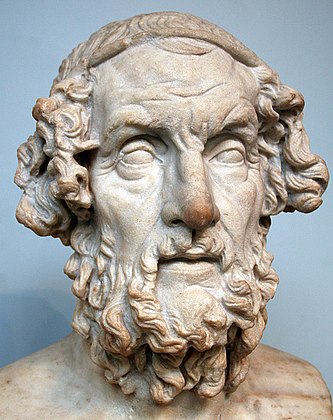
About Homer