Naturally man tended to lose his sense of scale and relation. A straight line, or a combination of straight lines, may have still a sort of artistic unity, but what can be done in art with a series of negative symbols? Even if the negative were continuous, the artist might express at least a negation; but supposing that Omar's kinetic analogy of the ball and the players turned out to be a scientific formula! supposing that the highest scientific authority, in order to obtain any unity at all, had to resort to the middle-ages for an imaginary demon to sort his atoms! how could art deal with such problems, and what wonder that art lost unity with philosophy and science! Art had to be confused in order to express confusion; but perhaps it was truest, so.
•
Adams alludes to a well-known passage from the Rubaiyat of Omar Khayyam. In Edward FitzGerald's translation:
The Ball no Question makes of Ayes and Noes,
But Right and Left as strikes the Player goes;
And He that toss'd Thee down into the Field,
He knows about it all — HE knows — HE knows!
What It Means
This is a placeholder explanation generated by the low-overhead model. It interprets "Naturally man tended to lose his sense of scale and relation. A straight line, or a combination of straight lines, may have still a sort of artistic unity, but what can be done in art with a series of negative symbols? Even if the negative were continuous, the artist might express at least a negation; but supposing that Omar's kinetic analogy of the ball and the players turned out to be a scientific formula! supposing that the highest scientific authority, in order to obtain any unity at all, had to resort to the middle-ages for an imaginary demon to sort his atoms! how could art deal with such problems, and what wonder that art lost unity with philosophy and science! Art had to be confused in order to express confusion; but perhaps it was truest, so.
•
Adams alludes to a well-known passage from the Rubaiyat of Omar Khayyam. In Edward FitzGerald's translation:
The Ball no Question makes of Ayes and Noes,
But Right and Left as strikes the Player goes;
And He that toss'd Thee down into the Field,
He knows about it all — HE knows — HE knows!

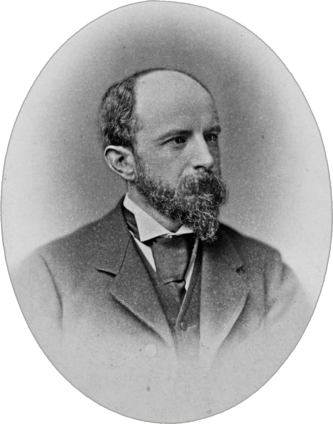
About Henry Adams