By sanctifying cruelty, early Christianity set a precedent for more than a millennium of systematic torture in Christian Europe. If you understand the expressions to burn at the stake, to hold his feet to the fire, to break a butterfly on the wheel, to be racked with pain, to be drawn and quartered, to disembowel, to flay, to press, the thumbscrew, the garrote, a slow burn, and the iron maiden (a hollow hinged statue lined with nails, later taken as the name of a heavy-metal rock band), you are familiar with a fraction of the ways that heretics were brutalized during the Middle Ages and early modern period. During the Spanish Inquisition, church officials concluded that the conversions of thousands of former Jews didn’t take. To compel the conversos to confess their hidden apostasy, the inquisitors tied their arms behind their backs, hoisted them by their wrists, and dropped them in a series of violent jerks, rupturing their tendons and pulling their arms out of their sockets. Many others were burned alive, a fate that also befell Michael Servetus for questioning the trinity, Giordano Bruno for believing (among other things) that the earth went around the sun, and William Tyndale for translating the Bible into English. Galileo, perhaps the most famous victim of the Inquisition, got off easy: he was only shown the instruments of torture (in particular, the rack) and was given the opportunity to recant for “having held and believed that the sun is the center of the world and immovable, and that the earth is not the center and moves.”
What It Means
This is a placeholder explanation generated by the low-overhead model. It interprets "By sanctifying cruelty, early Christianity set a precedent for more than a millennium of systematic torture in Christian Europe. If you understand the expressions to burn at the stake, to hold his feet to the fire, to break a butterfly on the wheel, to be racked with pain, to be drawn and quartered, to disembowel, to flay, to press, the thumbscrew, the garrote, a slow burn, and the iron maiden (a hollow hinged statue lined with nails, later taken as the name of a heavy-metal rock band), you are familiar with a fraction of the ways that heretics were brutalized during the Middle Ages and early modern period. During the Spanish Inquisition, church officials concluded that the conversions of thousands of former Jews didn’t take. To compel the conversos to confess their hidden apostasy, the inquisitors tied their arms behind their backs, hoisted them by their wrists, and dropped them in a series of violent jerks, rupturing their tendons and pulling their arms out of their sockets. Many others were burned alive, a fate that also befell Michael Servetus for questioning the trinity, Giordano Bruno for believing (among other things) that the earth went around the sun, and William Tyndale for translating the Bible into English. Galileo, perhaps the most famous victim of the Inquisition, got off easy: he was only shown the instruments of torture (in particular, the rack) and was given the opportunity to recant for “having held and believed that the sun is the center of the world and immovable, and that the earth is not the center and moves.”" in the context of "Steven Pinker, The Better Angels of Our Nature (2012)" to mean that wisdom is timeless.

Tags
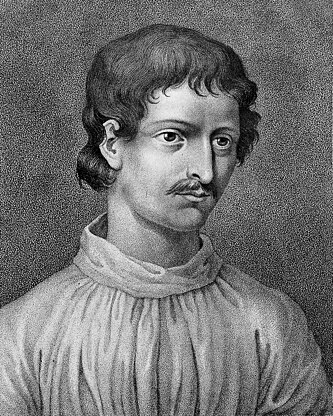
About Giordano Bruno