Link Copied!
George Stigler Quotes (1911-1991)
Politician, Leader, Scientist

About George Stigler
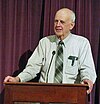
George Joseph Stigler (January 17, 1911 – December 1, 1991) was a U.S. economist. He won the Nobel Memorial Prize in Economic Sciences in 1982, and was a key leader of the Chicago School of Economics, along with his close friend Milton Friedman.
Best George Stigler Quotes
Shortest
Earliest
Explore our curated collection of the most famous and impactful George Stigler quotes.
“Unexpected changes, on the contrary, lead to windfall gains or losses for those who are in the right or wrong places at a given time.”
“The essence of scientific progress is to edge up this ladder from ignorance to knowledge, and it is complicated by the fact that the ladder keeps getting longer!”
“Economists are neither distinctively good nor bad, no more or less virtuous or brave or generous or faithful than the sum of mankind, and certainly no more modest.”
“Some important aspects of important aspects of economic organization take on a new meaning when they are considered from the viewpoint of the search of information.”

“In the 1950s, I proposed the survivor method of determining the efficient sizes of enterprises, and worked on delivered price systems, vertical integration, and similar topics.”
“Footnotes are not an occasional token of respect for an obsolete and purposeless tradition. It will come as a shock to many, I am sure, even to realize that references can be checked.”
“One should hardly have to tell academicians that information is a valuable resource: knowledge is power. And yet this occupies a slum dwelling in the town of economics. Mostly it is ignored.”
“Whether one is a conservative or a radical, a protectionist or a free trader, a cosmopolitan or a nationalist, a churchman or a heathen, it is useful to know the causes and consequences of economic phenomena.”
“Dr. Smith and all of his sensible disciples have believed that people would not strive to do anything well unless there were a reasonable measure of agreement between the success of their efforts and the rewards they would receive.”
“The delicate and intricate pattern of competition and cooperation in the economic behavior of the hundreds of thousands of citizens of Stockholm offers a challenge to the economist that is perhaps as complex as the challenges of the physicist and the chemist.”

“The user of a theory has a simpler task: his not to reason why, his but to sigh and try. If the right element in the diverse situations has been isolated, the theory will work: it will yield predictions better than those which can be reached with any alternative theory.”

“A useful role exists for the economist is making calculations of the prospective costs and/or benefits of alternative policies. This role is precisely the one Keynes had in mind, I assume, when he expressed the hope that we would become useful after the fashion of dentists.”
“Prices instruct us on what people desire, but prices do not tell us why those things are desired. Our desires are accepted as a datum by economists: desires are some amalgam of biological needs, the cultural values of the society in which we grow up, and our own experiments.”
“Lacking education, lacking a tenacity of purpose, lacking a willingness to work hard, he will not be an object of employers' competition. What leader of Negro thought is fostering the ancient virtues of diligence and honesty and loyalty? It is so much easier to seek quotas for Negroes?”
“I do not conceal my lack of admiration for a pain fully long list of redistributive measures undertaken by modern governments. Many serve no ethically accepted purpose such as compassion for the needy; indeed, they serve only as recognition of which groups possess or lack political influence.”
“Unlike the members of the physical and biological sciences, the economist is asked to explain his work in a manner that is interesting and convincing to a weary listener. Yet there is no reason to believe that the explanation of our economic and social world is inherently simpler than the explanation of our physical world.”

“A rational man must be guided by the incentive system within which he operates. No matter what his own personal desires, he must be discouraged from certain activities if they carry penalties and attracted toward others if they carry large rewards. The carrot and the stick guide scientists and politicians as well as donkeys.”
“We are entitled to be disappointed, but not to be surprised, by the persistence of governmental intervention in economic life. A school of thought attributes great influence to public opinion in the movements toward or away from laissez-faire. Among the many members of this school one may mention Albert Venn Dicey, John Maynard Keynes, and Milton Friedman.”
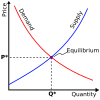
“So the price system gives innumerable messages on the state of supply and demand for each commodity or service at each place where it is bought or produced. If a city is in short supply for windows (following a hailstorm) or has an excess supply of workers, the movements of prices and wages communicate the facts to other communities. Some messages are swift and others slow.”
“For consumers, the price message is clear: economize on goods that are in short supply relative to demand, and splurge on those in ample supply: eat raspberries in summer, and ski in winter. But the accommodating is not done just by consumers: resorts in the Caribbean are much cheaper in July than in January, precisely because people are not so eager to vacation in hot, humid places.”
“In spite of assigning little influence of economists' preachings on actual public policy, I do not believe that economists' influence is negligible. The reconciliation of these views lies in the fact that economists are scientists as well as preachers. Our science seeks to understand how economic institutions and economic systems work, and no informed person can deny that we have made much progress in this work.”
“It was in the 1960s that I began the detailed study of public regulation. My interests were aroused, and my faith in the cliches of the subject destroyed, as so often with other subjects, by the discussions with my friend, Aaron Director. This wonderful man is that rarest of scholars: a clear-headed, imaginative, erudite man who enjoys the task of constructing luminous and original theories but does not even write them down!”

“The great disservice of the leaders of Negro opinion was to direct the discontent at the white population. It was proper to demand political rights that only a majority could confer. It was proper to ask the white population to assist in the rise of the Negro—a small enough restitution for the unreversible mistakes of the past. But it was a terrible disservice to identify the white man as the main obstacle to the rise of the Negro.”

“Early in my professional life, I found that many areas of economics attracted me. I started working and publishing in price theory by 1938. In 1946, I published an early work on linear programming (The Cost of Subsistence) which solved the problem only approximately; George Dantzig soon presented the exact solution. In the 1940s, I began empirical work on price theory, starting with a test of the kinked oligopoly demand curve theory of rigid prices.”
“Price dispersion is a manifestation — and, indeed, it is the measure — of ignorance in the market. Dispersion is a biased measure of ignorance because there is never absolute homogeneity in the commodity if we include the terms of sale within the concept of the commodity. Thus, some automobile dealers might perform more service, or carry a larger range of varieties in stock, and a portion of the observed dispersion is presumably attributable to such differences. But it would be metaphysical, and fruitless, to assert that all dispersion is due to heterogeneity.”

George Stigler Quotes by Topic
Find exactly what you are looking for by browsing this categorized list of George Stigler quotes by topic.
George Stigler on Economic history 2 quotes
“Economics, I thus believe, has a useful past, a past that is useful in dealing with the future.”

George Stigler on The Road to Serfdom
“It is a fair reading of The Road to Serfdom to say that forty years more of the march toward socialism would lead to major losses of the political and economic freedom of individuals. Yet in those forty years we have seen that continuous expansion of the state in Sweden and England, even in Canada and the United States, without consequences for personal freedom so dire as those he predicted.”

George Stigler on Price theory
“Early in my professional life, I found that many areas of economics attracted me. I started working and publishing in price theory by 1938. In 1946, I published an early work on linear programming (The Cost of Subsistence) which solved the problem only approximately; George Dantzig soon presented the exact solution. In the 1940s, I began empirical work on price theory, starting with a test of the kinked oligopoly demand curve theory of rigid prices.”
George Stigler on Economics
“The first and the purest demand of society is for scientific knowledge: knowledge of how the economic system works. Knowledge of the consequences of economic actions. Knowledge of the causes of unemployment, of the effects of various taxes, of the sources of income inequality. Whether one is a conservative or a radical, a protectionist or a free trader, a cosmopolitan or a nationalist, a churchman or a heathen, it is useful to know the causes and consequences of economic phenomena.”
George Stigler on Public choice
“The Principle of Legitimacy tells us that the sum of these deadweight losses is less than the legislature's estimate of the gains from the redistribution of income, but Legitimacy does not tell us that these are desirable transfers, i.e, that one dollar taken from the general consumer and given to a well-paid employee of the merchant marine constitutes a net increase in the utility of the nation. If I challenge this interpretation, all that I will be doing is asserting that George Stigler's tastes are not those of the Congress, and who, besides myself, cares about that? Indeed, even I have become reconciled to the fact that American society does not fully share my preferences.”

George Stigler on Minimum wage
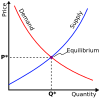
“The minimum wage provisions of the Fair Labor Standards act of 1938 have been repealed by inflation. Many voices are now taking up the cry for a higher minimum, say, of 60 to 75 cents per hour. Economists have not been very outspoken on this type of legislation. It is my fundamental thesis that they can and should be outspoken, and singularly agreed. The popular objective of minimum wage legislation-the elimination of extreme poverty-is not seriously debatable. The important questions are rather (1) Does such legislation diminish poverty? (2) Are there efficient alternatives? The answers are, if I am not mistaken, unusually definite for questions of economic policy. If this is so, these answers should be given.”

George Stigler on Division of labor
“The last of Smith’s regrettable failures is one for which he is overwhelmingly famous – the Division of labor. How can it be that the famous opening chapters of his book, and the pin factory he gave immortality, can be considered a failure? Are they not cited as often as any passages in all economics? Indeed, over the generations they are. The failure is different: almost no one used or now uses theory of Division of labor, for the excellent reason that there is scarcely such a theory. … there is no standard, operable theory to describe what Smith argued to be the mainspring of economic progress. Smith gave the Division of labor an immensely convincing presentation – it seems to me as persuasive a case for the power of specialization today as it appeared to Smith. Yet there is no evidence, so far as I know, of any serious advance in theory of the subject since his time, and specialization is not an integral part of the modern theory of production, which may well be an explanation for the fact that the modern theory of economies of scale is little more than a set of alternative possibilities.”

George Stigler on Specialization
“The last of Smith’s regrettable failures is one for which he is overwhelmingly famous – the division of labor. How can it be that the famous opening chapters of his book, and the pin factory he gave immortality, can be considered a failure? Are they not cited as often as any passages in all economics? Indeed, over the generations they are. The failure is different: almost no one used or now uses theory of division of labor, for the excellent reason that there is scarcely such a theory. … there is no standard, operable theory to describe what Smith argued to be the mainspring of economic progress. Smith gave the division of labor an immensely convincing presentation – it seems to me as persuasive a case for the power of specialization today as it appeared to Smith. Yet there is no evidence, so far as I know, of any serious advance in theory of the subject since his time, and specialization is not an integral part of the modern theory of production, which may well be an explanation for the fact that the modern theory of economies of scale is little more than a set of alternative possibilities.”
George Stigler on Chicago school of economics
“In the 1930s economics appeared to be a little different at the University of Chicago than elsewhere, but the same statement could be made about most major universities. Frank Knight was skeptical of the moral and intellectual content of political behavior and particularly hostile to central economic planning, but he was also severely critical of the ethical basis of a competitive economy. No doctrinaire defender of private enterprise would find him a source of strength. Henry Simons had preached a form of laissez-faire in his famous 1934 pamphlet A Positive Program for Laissez Faire, but what a form! He proposed nationalization of basic industries … [and] urged an extremely egalitarian policy in the taxation of income and detailed regulation of business practices … Much of his program was almost as harmonious with socialism as with private-enterprise capitalism.… Jacob Viner, the other major figure, had nineteenth-century liberal tastes, but rebelled against simplified or “extreme” positions. The rest of the faculty were highly varied in their policy preferences: Paul Douglas favored a large economic role for the state; Simeon Leland was a traditionalist in taxation; Henry Millis was an old-fashioned labor economist; Lloyd Mints wrote only on central bank policy; Henry Schultz stuck to his mathematical and statistical knitting; and Oskar Lange was a socialist.”

What George Stigler Said About Others
Discover personal opinions George Stigler shared regarding contemporaries.
George Stigler on Friedrich Hayek
“Mrs. Hayek, I want you each day in the future to address your husband and inquire what his progress has been in what I consider to be one of the most interesting and intriguing fields, the evolution of the work of scholars.”

George Stigler on John Maynard Keynes
“Of all economists, Lord Keynes was most sensitive to the conditions of the next moment—he was a Geiger counter of future headlines. This was a most extraordinary gift, and it may have extraordinary consequences for his theories.”

Quotes About George Stigler
Gain deeper perspective through quotes about George Stigler from others.
Robert Barro on George Stigler
“George’s most distinctive contributions to the Chicago school involved studies of the actual effects of government regulations, such as in the electric utility and financial sectors.”
Frank Van Dun on George Stigler
“I recall an incident involving the late George Stigler at a conference in Spain in the 1980s. Hearing that I had written a book on reason and natural law, Stigler started to ridicule reason, going so far as to say that there is as much reason in a monkey's antics as in any human act. At that point I asked him whether he was trying to tell me something about how he wrote his books; he gave me a blank stare and stormed out of the room.”

About George Stigler
George Joseph Stigler (January 17, 1911 – December 1, 1991) was a U.S. economist. He won the Nobel Memorial Prize in Economic Sciences in 1982, and was a key leader of the Chicago School of Economics, along with his close friend Milton Friedman.