Link Copied!
G. K. Chesterton Quotes (1874-1936)
Writer, Poet
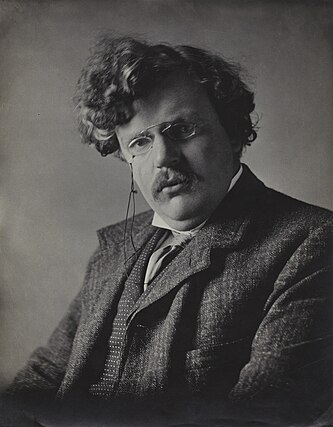
































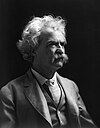




















































About G. K. Chesterton
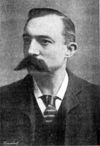
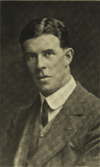
Gilbert Keith Chesterton (29 May 1874 – 14 June 1936) was a British writer whose prolific and diverse output included works of philosophy, ontology, poetry, play writing, journalism, public lecturing and debating, literary and art criticism, biography, Christian apologetics (particularly for Catholicism), and fiction, including fantasy and detective fiction. He has been called the "prince of paradox".
Best G. K. Chesterton Quotes
Shortest
Earliest
Explore our curated collection of the most famous and impactful G. K. Chesterton quotes.
“All government is an ugly necessity.”



“The simplification of anything is always sensational.”
“America has a new delicacy, a coarse, rank refinement.”

“The night we went to Birmingham by way of Beachy Head.”

“It is terrible to contemplate how few politicians are hanged.”
“The one stream of poetry which is continually flowing is slang.”



“A puritan is a person who pours righteous indignation into the wrong things.”


G. K. Chesterton Quotes by Topic
Find exactly what you are looking for by browsing this categorized list of G. K. Chesterton quotes by topic.
G. K. Chesterton on Doom 5 quotes
“"Spears at the charge!" yelled Mark amain. "Death on the gods of death! Over the thrones of doom and blood Goeth God that is a craftsman good, And gold and iron, earth and wood, Loveth and laboureth.”

G. K. Chesterton on Existence of God 5 quotes
“The strongest saints and the strongest sceptics alike took positive evil as the starting-point of their argument. If it be true (as it certainly is) that a man can feel exquisite happiness in skinning a cat, then the religious philosopher can only draw one of two deductions. He must either deny the existence of God, as all atheists do; or he must deny the present union between God and man, as all Christians do. The new theologians seem to think it a highly rationalistic solution to deny the cat.”

G. K. Chesterton on Journalism 4 quotes
“I know that journalism largely consists in saying 'Lord Jones Dead' to people who never knew Lord Jones was alive.”

G. K. Chesterton on Christian anarchism 4 quotes
“But the truth is that it is only by believing in God that we can ever criticise the Government. Once abolish the God, and the Government becomes the God.”

G. K. Chesterton on Education 3 quotes
View all 3 quotes on Education →G. K. Chesterton on Travel 3 quotes
View all 3 quotes on Travel →G. K. Chesterton on Christianity 3 quotes
“The Christian ideal has not been tried and found wanting. It has been found difficult and left untried.”

G. K. Chesterton on Heresy 3 quotes
“Truths turn into dogmas the instant that they are disputed. Thus every man who utters a doubt defines a religion.”

G. K. Chesterton on Comedy 3 quotes
“Don't you know Sunday? Don't you know that his jokes are always so big and simple that one has never thought of them?”

G. K. Chesterton on Horses 3 quotes
“Age beyond age on British land, Aeons on aeons gone, Was peace and war in western hills, And the White Horse looked on.”

G. K. Chesterton on Fairy tale 3 quotes
“Even the tyrant never rules by force alone; but mostly by fairy tales. And so it is with the modern tyrant, the great employer.”

G. K. Chesterton on Skepticism 3 quotes
“In the act of destroying the idea of Divine authority we have largely destroyed the idea of that human authority by which we do a long-division sum. With a long and sustained tug we have attempted to pull the mitre off pontifical man; and his head has come off with it.”

What G. K. Chesterton Said About Others
Discover personal opinions G. K. Chesterton shared regarding contemporaries.
G. K. Chesterton on Charles Dickens 10 quotes
“That is the truth in the suggestion that Dickens was sentimental. It means that he probably felt most sociable when he was solitary.”

G. K. Chesterton on Alfred the Great 6 quotes
“When Alfred's word was ended Stood firm that feeble line, Each in his place with club or spear, And fury deeper than deep fear, And smiles as sour as brine.”

G. K. Chesterton on Thomas Carlyle 4 quotes
“He came and spoke a word, and the chatter of rationalism stopped, and the sums would no longer work out and be ended. He was a breath of Nature turning in her sleep under the load of civilisation, a stir in the very stillness of God to tell us He was still there.”

G. K. Chesterton on Jane Austen 3 quotes
“She knew what she knew, like a sound dogmatist: she did not know what she did not — like a sound agnostic.”
G. K. Chesterton on Oscar Wilde 3 quotes
“Oscar Wilde said that sunsets were not valued because we could not pay for sunsets. But Oscar Wilde was wrong; we can pay for sunsets. We can pay for them by not being Oscar Wilde.”

G. K. Chesterton on Millionaire 3 quotes
“While poor panting millionaires, poor tired earls and poor God-forsaken American men of culture are plodding about Italy for literary inspiration, Charles Dickens made up the whole of that Italian romance... from the faces of two London organ grinders.”

G. K. Chesterton on Thomas Aquinas 3 quotes
“St. Thomas confronts other creeds of good and evil, without at all denying evil, with a theory of two levels of good. The supernatural order is the supreme good, as for any Eastern mystic; but the natural order is good; as solidly good as it is for any man in the street.”

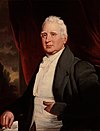
G. K. Chesterton on William Cobbett 2 quotes
“William Cobbett is the noblest English example of the noble calling of the agitator.”
G. K. Chesterton on Robert Browning 2 quotes
“He concentrated on the special souls of men; seeking God in a series of personal interviews.”

G. K. Chesterton on John Ruskin 2 quotes
“The point and stab of his challenge still really stands and sticks, like a dagger in a dead man.”

G. K. Chesterton on Women 2 quotes
“If you convey to a woman that something ought to be done, there is always a dreadful danger that she will suddenly do it.”

G. K. Chesterton on George Bernard Shaw 2 quotes
“I never read a reply by Shaw that did not leave me in better and not worse temper or frame of mind; which did not seem to come out of inexhaustible fountains of fairmindedness and intellectual geniality; which did not savor somehow of that native largeness which the philosophers attributed to Magnanimous Man.”

Quotes About G. K. Chesterton
Gain deeper perspective through quotes about G. K. Chesterton from others.
Hannah Arendt on G. K. Chesterton
“The insistence of the Christian doctrine on man's limited condition was somehow enough of a philosophy to allow its adherents a very deep insight into the essential inhumanity of all those modern attempts – psychological, technical, biological – to change man into the monster of superman. They realized that a pursuit of happiness which actually means to wipe away all tears will pretty quickly end by wiping out all laughter. It was again Christianity which taught them that nothing human can exist beyond tears and laughter, except the silence of despair.”

Cecil Chesterton on G. K. Chesterton
“Mr Chesterton was not mistaken in his vocation when he set out to write stories. He is a born story-teller, which is quite a different thing from being a born novelist. The old trade of story-telling is, as he himself has said, a much older thing than the modern art of fiction. The Oriental who spread his carpet in the marketplace, the medieval bard who sang a ballad at his master's feast, made no appeal to that curiosity about the varieties of the human soul which is increasingly the inspiration of the modern novel. If he touched on human psychology at all he dealt only with those primal passions and desires which are common to all normal men. But, for the interest of his art, he depended simply upon his capacity to tell a good story, and to tell it well. In the last resort, Mr. Chesterton's novels depend for their interest on the same power.”
Cristopher Clausen on G. K. Chesterton
“In its fundamental conception, as well as in many of the significant details of its working out, Lord of the Rings is heavily indebted to G. K. Chesterton's now little read poem of 1911,The Ballad of the White Horse.''''' The major theme of both works is the war and eventual victory, despite all odds, of an alliance of good folk against vastly more powerful forces of evil, and the return of a king to his rightful state. Like Lord of the Rings'', Chesterton's poem is set in a heroic society after the decay of a highly civilized imperial power — in England, that is to say, in the aftermath of the Roman Empire. (Tolkien's Minas Tirith, built on seven levels, greatly resembles a medieval idealization of Rome.) King Alfred, its hero, is fighting a losing war to save his kingdom from complete conquest by the Danes. As one would expect with Chesterton, it is a war of white against black, of Christianity against a diabolical paganism that has defeated Rome and is now trying to make all good men its slaves]]. ... The enemy is not simply Danes, or barbarians in general, but a wholly malignant and almost irresistible force that stands behind all the enemies of Christianity: This power blights everything it touches — there are repeated references to its distorting effects even on the natural world — and the men who serve it become like Tolkien's Orcs. ... To fight against this menace, Alfred, hiding in exile, summons three kindreds of free, Christian peoples as allies. Alfred himself, like Tolkien's Aragorn, is an idealized heroic figure who roams around in humble disguise and is sometimes mistreated by the ignorant. Instead of Dwarves, Elves, and Men of Numenorean descent, he leads an alliance of Saxons, Celts, and Romans.'''”
Neil Gaiman on G. K. Chesterton 2 quotes
“Chesterton was important — as important to me in his way as C. S. Lewis had been. You see, while I loved Tolkien and while I wished to have written his book, I had no desire at all to write like him. Tolkien's words and sentences seemed like natural things, like rock formations or waterfalls, and wanting to write like Tolkien would have been, for me, like wanting to blossom like a cherry tree or climb a tree like a squirrel or rain like a thunderstorm. Chesterton was the complete opposite. I was always aware, reading Chesterton, that there was someone writing this who rejoiced in words, who deployed them on the page as an artist deploys his paints upon his palette. Behind every Chesterton sentence there was someone painting with words, and it seemed to me that at the end of any particularly good sentence or any perfectly-put paradox, you could hear the author, somewhere behind the scenes, giggling with delight.”

Robert E. Howard on G. K. Chesterton 2 quotes
“There is great poetry being written now. G.K. Chesterton, for instance.”

Quentin Lauer on G. K. Chesterton
“To speak of ideals and their significance as goals to be reached for is to put one's finger on an ever-recurring theme in Chesterton's productive life, the indignant rejection of pessimism in any and all of its forms. This is not to say that he was unaware that there is evil — a great deal of it — in this world. His life was one continuous campaign against the evils he perceived, one of the chief of which was the denial that there is good in the world, the denial that life is basically good.”
George Orwell on G. K. Chesterton
“Ten or twenty years ago, the form of nationalism most closely corresponding to Communism today was political Catholicism. Its most outstanding exponent – though he was perhaps an extreme case rather than a typical one – was G. K. Chesterton. Chesterton was a writer of considerable talent who chose to suppress both his sensibilities and his intellectual honesty in the cause of Roman Catholic propaganda. During the last twenty years or so of his life, his entire output was in reality an endless repetition of the same thing, under its laboured cleverness as simple and boring as ‘Great is Diana of the Ephesians’. Every book that he wrote, every paragraph, every sentence, every incident in every story, every scrap of dialogue, had to demonstrate beyond possibility of mistake the superiority of the Catholic over the Protestant or the pagan. But Chesterton was not content to think of this superiority as merely intellectual or spiritual: it had to be translated into terms of national prestige and military power, which entailed an ignorant idealization of the Latin countries, especially France. Chesterton had not lived long in France, and his picture of it – as a land of Catholic peasants incessantly singing the Marseillaise over glasses of red wine – had about as much relation to reality as Chu Chin Chow has to everyday life in Baghdad. And with this went not only an enormous over-estimation of French military power (both before and after 1914-18 he maintained that France, by itself, was stronger than Germany), but a silly and vulgar glorification of the actual process of war. Chesterton’s battle poems, such as ‘Lepanto’ or ‘The Ballad of Saint Barbara’, make ‘The Charge of the Light Brigade’ read like a pacifist tract: they are perhaps the most tawdry bits of bombast to be found in our language. The interesting thing is that had the romantic rubbish which he habitually wrote about France and the French army been written by somebody else about Britain and the British army, he would have been the first to jeer. In home politics he was a Little Englander, a true hater of jingoism and imperialism, and according to his lights a true friend of democracy. Yet when he looked outwards into the international field, he could forsake his principles without even noticing he was doing so. Thus, his almost mystical belief in the virtues of democracy did not prevent him from admiring Mussolini. Mussolini had destroyed the representative government and the freedom of the press for which Chesterton had struggled so hard at home, but Mussolini was an Italian and had made Italy strong, and that settled the matter. Nor did Chesterton ever find a word to say about imperialism and the conquest of coloured races when they were practised by Italians or Frenchmen. His hold on reality, his literary taste, and even to some extent his moral sense, were dislocated as soon as his nationalistic loyalties were involved.”

Robert Royal on G. K. Chesterton 2 quotes
“The meeting between Chesterton and Il Duce occurred in 1929, ten years before the war, at a time when, whatever his other faults, Mussolini had reintroduced a mark spirit of optimism and freshness to an Italy that had formerly been pessimistic and stagnant. Throughout the 1920s, Chesterton thought he saw in the Italian leader qualities that might have offset certain evils in Britain. It is important to keep in mind that whatever the misreadings of fascism, Chesterton always had some quite specific British problem in view when he praises Mussolini.”
Rebecca West on G. K. Chesterton
“I have the greatest possible admiration for “Tremendous Trifles” and the other fairy tales – Heavens! how I can see Mr. Chesterton's beaming face crying happily, “But that’s just it! Life is a fairy tale!” Heavens! – but I believe his view of life to be based on a misconception. To put it in a theological way, he denies that God made the brain as well as the heart. He despises wisdom...Like all sentimentalists he is cruel.”

Misattributed Quotes
Quotes mistakenly credited to G. K. Chesterton
“An open mind is really a mark of foolishness, like an open mouth. Mouths and minds were made to shut; they were made to open only in order to shut.”
“A weak mind is like a microscope, which magnifies trifling things but cannot receive great ones.”
“A man can never quite understand a boy, even when he has been the boy.”
“Moral issues are always terribly complex for someone without principles.”
About G. K. Chesterton
Gilbert Keith Chesterton (29 May 1874 – 14 June 1936) was a British writer whose prolific and diverse output included works of philosophy, ontology, poetry, play writing, journalism, public lecturing and debating, literary and art criticism, biography, Christian apologetics (particularly for Catholicism), and fiction, including fantasy and detective fiction. He has been called the "prince of paradox".