Link Copied!
Friedrich Schleiermacher Quotes (1768-1834)
Philosopher, Theologian



About Friedrich Schleiermacher
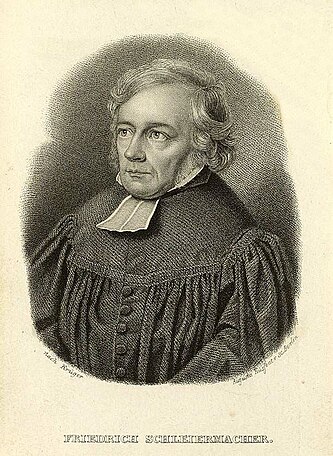
Friedrich Daniel Ernst Schleiermacher (November 21, 1768 – February 12, 1834) was a German theologian and philosopher known for his attempt to reconcile the criticisms of the Enlightenment with traditional Protestant orthodoxy.
Best Friedrich Schleiermacher Quotes
Shortest
Earliest
Explore our curated collection of the most famous and impactful Friedrich Schleiermacher quotes.
“Jämmerlich ist freilich jene praktische Philosophie der Franzosen und Engländer, von denen man meint, sie wüßten so gut, was der Mensch sei, unerachtet sie nicht darüber spekulierten, was er sein solle.”
“Him pervaded the Cosmic Spirit, the Infinity was his beginning and his end, the Universe his only and everlasting love. In holy innocence and deep humility he beheld himself mirrored in the eternal world, and perceived how himself was its most amiable mirror. Full of religion was he and full of Holy Spirit. Wherefore he stands there, alone and unequalled a master of his art, but sublime above the profane rabble, a peerless beacon forever.”
“Oh, that we had our eyes more and more steadily fixt on the risen Savior! Oh, that we could ever be learning more and more from Him to breathe out blessing, as He did when He imparted His Spirit to the disciples! Oh, that we were more and more learning like Him to encourage the foolish and slow of heart to joyful faith in the divine promises, to active obedience to the divine will of their Lord and Master, to the glad enjoyment and use of all the heavenly treasures that He has thrown open to us! Oh, that we were ever speaking more effectively to all connected with us, of the kingdom of God and of our inheritance in it, so that they might see why it was necessary for Christ to suffer, but also into what glory He has gone! These are our desires, and they are not vain desires.”

“Moreover, in Christ's second discourse, the mode in which the mention of Jonas is understood in Matthew, verse 40, is wholly unsuited to the context and to the application which even there is made of it; and if we do not take this for a later interpolation, for which no adequate inducement suggests itself, it must be considered as an erroneous comment of the reporter, which he has mixed up with Christ’s own words, of course without being conscious of it, a thing which might easily happen when his recollection had become dim and confused. In addition to the signs already adduced of Matthew’s reporter having been so circumstanced comes the fact, that he omits the little incident related in Luke, which intervenes between Christ’s two discourses, namely, the admiring ejaculation of a woman in the crowd and the reply to it.”
“Between the beginning of our existence and our present life and aims there lies a time in which lust was the prevailing power; in which it conceived and brought forth sin. If we are honest, we can say that there is a period on which we look back only with the feeling that we appear to ourselves to have become since then different men. That which was then our innermost I and Self has now become something far off and strange to us; and the law of divine appointment, which has now through the grace of God become the law of our life, which we love and obey, was then far off and strange. We were only aware of it as an external force, impeding the free course of our life, just as now the separate stirrings of the flesh and of sin are a force which we do not ascribe to our real life. Thus, then, it is true that one life has ceased and another has begun. But the beginning of the new life is the new birth; and this holds good universally, If any man be in Christ, he is a new creature; the old is passed away, behold all is become new.”

“But the imparting of religion is not to be sought in books, like that of intellectual conceptions and scientific knowledge. The pure impression of the original product is too far destroyed in this medium, which, in the same way that dark-colored objects absorb the greatest proportion of the rays of light, swallows up everything belonging to the pious emotions of the heart, which cannot be embraced in the insufficient symbols from which it is intended again to proceed. Nay, in the written communications of religious feeling, everything needs a double and triple representation; for that which originally represented, must be represented in its turn; and yet the effect on the whole man, in its complete unity, can only be imperfectly set forth by continued and varied reflections. It is only when religion is driven out from the society of the living, that it must conceal its manifold life under the dead letter. Neither can this intercourse of heart with heart, on the deepest feelings of humanity, be carried on in common conversation.”

Friedrich Schleiermacher Quotes by Topic
Find exactly what you are looking for by browsing this categorized list of Friedrich Schleiermacher quotes by topic.
Friedrich Schleiermacher on God
“In saying we are in immediate relation with God, the latter term is used only to designate the Whence of our spontaneous and receptive life, of which we become aware in our feeling of absolute dependence.”

Friedrich Schleiermacher on Pragmatism
“Pitiful, to be sure, is what the pragmatic philosophy of the French and English is. … They are considered to be so well versed in the knowledge of what man is, despite their failure to speculate on what he should be.”

Friedrich Schleiermacher on Utilitarianism
“Those proud Islanders whom many unduly honour, know no watchword but gain and enjoyment. Their zeal for knowledge is only a sham fight, their worldly wisdom a false jewel, skilfully and deceptively composed, and their sacred freedom itself too often and too easily serves self-interest. They are never in earnest with anything that goes beyond palpable utility. All knowledge they have robbed of life and use only as dead wood to make masts and helms for their life's voyage in pursuit of gain.”
What Friedrich Schleiermacher Said About Others
Discover personal opinions Friedrich Schleiermacher shared regarding contemporaries.
Friedrich Schleiermacher on Baruch Spinoza 4 quotes
“As interpolation instead of interpretation was not then so common or so honourable as at present, I believed that a part of my work was well done. How was I to expect that, because I ascribed piety to Spinoza, I would myself be taken for a Spinozist ? Yet I had never defended his system, and anything philosophic that was in my book was manifestly inconsistent with the characteristics of his views and had quite a different basis than the unity of substance.”
Quotes About Friedrich Schleiermacher
Gain deeper perspective through quotes about Friedrich Schleiermacher from others.
Richard von Krafft-Ebing on Friedrich Schleiermacher
“In religion the primary element is a feeling of dependence, a fact which Schleiermacher recognized long before the later studies in anthropology and ethnography, founded on the observation of primitive conditions, had led to the same conclusion. It is only at a higher stage of culture that the second and essentially ethical element love of God enters into religious feeling. In the place of the evil spirits of the primitive peoples came the two-faced now kind, now angry creations of the more complicated mythologies, until, finally, the God of love, as the giver of eternal happiness, is reverenced, whether this be hoped for from Jehovah, as a blessing on earth; from Allah, as a physical blessing in Paradise; from Christ, as eternal bliss in heaven; or as the Nirvana of the Buddhists. In sexual desire, love, the expectation of unbounded happiness is the primary element. The feeling of dependence is of secondary development. The nucleus of this feeling exists in both parties, but it may remain undeveloped in one. As a rule, owing to her passive part in procreation and social conditions, it is more pronounced in woman; but exceptionally this is true of men having minds that approach the feminine type.”
About Friedrich Schleiermacher
Friedrich Daniel Ernst Schleiermacher (November 21, 1768 – February 12, 1834) was a German theologian and philosopher known for his attempt to reconcile the criticisms of the Enlightenment with traditional Protestant orthodoxy.