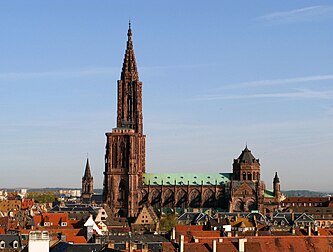
[I]n Strasbourg itself there were no gaps between past and present. Romanesque and Gothic Middle Ages, Baroque and the most recent constructions after 1871, all stood on top of each other, constituting, not exactly a harmonious unity, but nevertheless that unity and continuity of historical life which overcomes even the most enormous tensions and recalls the continuous struggle and the changing fortunes of the people. The Strasbourg Cathedral constitutes the most powerful center of this unit. It often seemed to us that it had been built not by the hand of man, but by eternity, as a warning to the fleeting generations of men, to serve the eternal with their weak strength, and in particular to serve the Germans to show themselves worthy of this cathedral. [...] And in looking at the marvelous Romanesque apse, I had the sensation that a supreme and impenetrable mystery was still hidden here (as perhaps happens in every great historical experience).
What It Means
This is a placeholder explanation generated by the low-overhead model. It interprets "[I]n Strasbourg itself there were no gaps between past and present. Romanesque and Gothic Middle Ages, Baroque and the most recent constructions after 1871, all stood on top of each other, constituting, not exactly a harmonious unity, but nevertheless that unity and continuity of historical life which overcomes even the most enormous tensions and recalls the continuous struggle and the changing fortunes of the people. The Strasbourg Cathedral constitutes the most powerful center of this unit. It often seemed to us that it had been built not by the hand of man, but by eternity, as a warning to the fleeting generations of men, to serve the eternal with their weak strength, and in particular to serve the Germans to show themselves worthy of this cathedral. [...] And in looking at the marvelous Romanesque apse, I had the sensation that a supreme and impenetrable mystery was still hidden here (as perhaps happens in every great historical experience)." in the context of "pp. 184-185" to mean that wisdom is timeless.
Tags

About Friedrich Meinecke