Link Copied!
Errol Morris Quotes (1948-)
Director
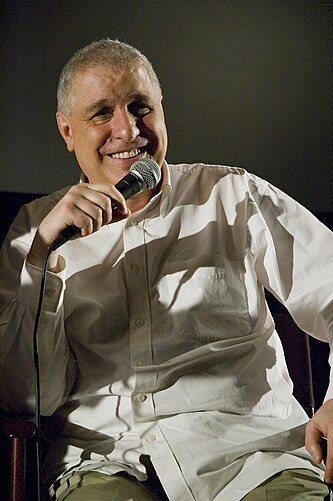
About Errol Morris
Errol Mark Morris (born February 5, 1948) is an American film director known for documentaries.
Best Errol Morris Quotes
Shortest
Earliest
Explore our curated collection of the most famous and impactful Errol Morris quotes.
“The pursuit of truth, properly considered, shouldn't stop short of insanity.”
“The proper route to an understanding of the world is an examination of our errors about it.”

“I am profoundly skeptical about our abilities to predict the future in general, and human behavior in particular.”


“You can think of my films as cautionary tales, but you might even think of them as despairing tales, because at least in a cautionary tale, you have this idea that by listening to the story you can assure a better outcome. Whereas I'm not at all convinced that's the case. In fact, if anything, I'm convinced that it's the opposite.”
“I believe that we face incredible obstacles in our attempts to see the world. Everything in our nature tries to deny the world around us; to refabricate it in our own image; to reinvent it for our own benefit. And so, it becomes something of a challenge, a task, to recover (or at least attempt to recover) the real world despite all the impediments to that end.”

“I like the idea of making films about ostensibly absolutely nothing. I like the irrelevant, the tangential, the sidebar excursion to nowhere that suddenly becomes revelatory. That's what all my movies are about. That and the idea that we're in possession of certainty, truth, infallible knowledge, when actually we're just a bunch of apes running around. My films are about people who think they're connected to something, although they're really not.”
“I gave someone a perverse argument not so long ago about why advertising is better than movies. You want to hear it? Movies operate from a really disingenuous premise, that people are heroes. I know a lot of people and have had an opportunity over the years to observe them. Are they heroes...? Let's put it this way. Advertising tries something simpler and more believable: Products as heroes. I guess the idea is: When all else fails, put your faith in conditioner.”

“Santayana said, "Those who cannot remember the past are condemned to repeat it." Really? Human nature being what it is, isn't it hopeless to expect that we can do better regardless of whether we remember anything or not? And what if what we remember leads us to false analogies and misunderstandings? I prefer: "Those who cannot remember the past are condemned to repeat it without a sense of ironic futility." Or how about this: "Those who cannot condemn the past repeat it in order to remember it."”
“You know, I have this version of the expulsion from the Garden of Eden. God, in expelling Adam and Eve, kind of felt bad. He had gotten very angry, right? You know, you get angry and then you feel, "Well, maybe I overreacted." So, God was in that kind of mood when he expelled Adam and Eve from the garden. But his hands were tied. He had to go through with it; he had made the decision. God doesn't want to constantly second-guess himself. But he thought, "I know. I'll give them self-deception. Things are going to be truly horrendous out there, but they'll never notice."”

“I like to think of myself as the ultimate anti-postmodernist post-modernist. Notwithstanding the unusual narrative or visual devices that appear in many of the films, what have kept me going for the three years of investigating [for The Thin Blue Line, was the belief that there answers to questions such as, Adams did it, didn't he? Or Harris did it, didn't he? That it's not just up for grabs. Today, I believe there's a kind of frisson of ambiguity. People think that ambiguity is somehow wonderful in its own right, an excuse for failing to investigate. What can I say? I think this view is wrong. At best, misguided. Maybe even reprehensible.”

“Correct me if I'm wrong here, but truth is something that arises out of the relationship between language and the world. If I look at a picture alone, it tells me nothing. In the previous incarnation of this lecture, I was going to put a picture of the Titanic and the Lusitania up on the screen. They look very, very similar - four smokestacks. They look almost identical. You look at either picture, true or false? Neither. Put a caption at the bottom of one of them, that changes everything. If you put in the caption, "This is the Lusitania," and the picture is a picture of the Lusitania, then the caption is true. However, the picture itself is neither true nor false. It's just a picture.”
“I believe that historical analogies are always wrong. This a long discussion, but, to me, the most dangerous thing about Chamberlain's capitulation to Hitler at Munich is not the fact that Munich happened and it led to further Nazi aggression and so on and so forth, but that the example of Munich has been used to support thousands upon thousands of bad policies and inappropriate decisions. LeMay called JFK's recommendation for a “quarantine” (that is, a blockade) in the Cuban Missile Crisis “worse than Munich”. Would nuclear war have been a better alternative? But nuclear war was averted by Kennedy's policies. And thirty years later the Soviet Union collapsed without the need for nuclear war. Was LeMay right? I don't think so. But again, the example of Munich was invoked to justify the invasion of Iraq. Appeasing Saddam, appeasing Hitler. The use of the Munich analogy does not clarify, it obscures. History is like the weather. Themes do repeat themselves, but never in the same way. And analogies became rhetorical flourishes and sad ex post facto justifications rather than explanations. In the end, they explain nothing.”
“There's the Mike Wallace approach, or you can call it the Michael Moore approach, which is the adversarial approach. In the end, that is not in the service of finding out anything. It's in service of dramatizing a received view: Namely, "This guy is an asshole, and now I will illustrate how this guy is an asshole by showing his inability to answer the questions I put to him." It's not what I'm about. It's not that one approach is good and the other is bad. They just have different valences. I like confrontation as much as the next guy. I'll give you the best example I can think of for why I like my method. [During] my interview with Emily Miller, one of the wacko eyewitnesses in The Thin Blue Line, she volunteered that she had failed to pick out Randall Adams in a police lineup. It wasn't me saying to her, "Emily Miller, how come you failed to pick out Randall Adams in a police lineup?" Why? Because I didn't know she failed to do it, because part of the trial record said she had successfully picked him out. When I heard this, not in response to some adversarial question, just her telling me her story, I asked her, "How did you know you failed to pick out Randall Adams?" She said, "I know because the policeman sitting next to me told me I had picked out the wrong person and pointed out the right person so I wouldn't make that mistake again."”

Errol Morris Quotes by Topic
Find exactly what you are looking for by browsing this categorized list of Errol Morris quotes by topic.
Errol Morris on Mr. Death: The Rise and Fall of Fred A. Leuchter, Jr. 6 quotes
“Isn't Fred a sweetie?”
Errol Morris on The Fog of War 5 quotes
“I've always wondered where explanations end and excuses begin. And is there a difference between excuses and explanations ... is an excuse a bad or self-serving explanation? I don't know. Maybe Newton's Law is an excuse for why bodies just stay at rest or in motion unless acted on by some external force. I look at the McNamara story as the-fog-of-war-ate-my-homework excuse. After all, if war is so complex, then no one is responsible.”
Errol Morris on Gates of Heaven 3 quotes
“I didn't make Gates of Heaven so that Werner Herzog would have to eat his shoe. It's not as if I decided to realize my potential as a human being in order to get somebody to ingest something distasteful. I specifically asked Werner not to eat his shoe.”
Errol Morris on The Thin Blue Line 2 quotes
“I've had people accuse me of being responsible for reenactment television, for infotainment television … The reenactments have been widely imitated, but the use of graphics in the Thin Blue Line, the use of close-ups of words, or parts of an actual document, is also something that has been imitated widely. It's now seen — and I could be wrong about this. I could have my history of the documentary confused and reinterpreted by myself in a self-serving way, I'm not sure — but I believe my use of these close-ups was something that's unusual and originates with Thin Blue Line. So I like to think of it as not the convention, but something that's come to be imitated widely. Even by myself.”

Errol Morris on Truth
“The pursuit of truth, properly considered, shouldn't stop short of insanity.”
Errol Morris on Prediction
“I am profoundly skeptical about our abilities to predict the future in general, and human behavior in particular.”

Errol Morris on Human behavior
“I am profoundly skeptical about our abilities to predict the future in general, and human behavior in particular.”

Errol Morris on Film
“Photography because of its causal relationship to the world seems to give us the truth or something close to the truth. I am skeptical about this for many reasons. But even if photography doesn't give us truth on a silver-platter, it can make it harder for us to deny reality. It puts a leash on fantasy, confabulation and self-deception. It provides constraints, borders. It circumscribes our ability to lie — to ourselves and to others.”
Errol Morris on Perversion
“I gave someone a perverse argument not so long ago about why advertising is better than movies. You want to hear it? Movies operate from a really disingenuous premise, that people are heroes. I know a lot of people and have had an opportunity over the years to observe them. Are they heroes...? Let's put it this way. Advertising tries something simpler and more believable: Products as heroes. I guess the idea is: When all else fails, put your faith in conditioner.”

Errol Morris on Self-deception
“You know, I have this version of the expulsion from the Garden of Eden. God, in expelling Adam and Eve, kind of felt bad. He had gotten very angry, right? You know, you get angry and then you feel, "Well, maybe I overreacted." So, God was in that kind of mood when he expelled Adam and Eve from the garden. But his hands were tied. He had to go through with it; he had made the decision. God doesn't want to constantly second-guess himself. But he thought, "I know. I'll give them self-deception. Things are going to be truly horrendous out there, but they'll never notice."”

About Errol Morris
Errol Mark Morris (born February 5, 1948) is an American film director known for documentaries.