Link Copied!
Empedocles Quotes (-490--430)
Philosopher, Author, Poet
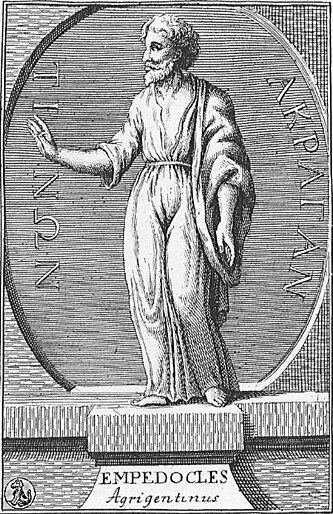


About Empedocles
Empedocles (c. 490 BC – c. 430 BC) was a poet, statesman, and pre-Socratic philosopher from the Greek colony of Agrigentum in Sicily. Two of his philosophical verse texts, On Nature and Purifications, survived antiquity in fragmentary form; these fragments comprise the only works considered to be of genuine Empedoclean authorship.Leonard, William E. (1908). The Fragments of Empedocles. The Open Court Publishing Company. p. 3.
Best Empedocles Quotes
Shortest
Earliest
Explore our curated collection of the most famous and impactful Empedocles quotes.
“οὐδέ τι τοῦ παντὸς κενεὸν πέλει οὐδὲ περισσόν.
• Nothing of the All is either empty or superfluous.”
• Nothing of the All is either empty or superfluous.”

“ἧι γὰρ καὶ πάρος ἔσκε, καὶ ἔσσεται, οὐδέ ποτ’, οἴω,/τούτων ἀμφοτέρων κενεώσεται ἄσπετος αἰών.
• As it has long been and shall be, not ever, I think, will unfathomable time be emptied of either.”
• As it has long been and shall be, not ever, I think, will unfathomable time be emptied of either.”
“ἀλλὰ τὸ μὲν πάντων νόμιμον διάτ᾽ εὐρυμέδοντος/αἰθέρος ἠνεκέως τέταται διά τ᾽ ἀπλέτου αὐγῆς
• But what is lawful for all extends across wide-ruling aether and, without cease, through endless sunshine.”
• But what is lawful for all extends across wide-ruling aether and, without cease, through endless sunshine.”
“ὄλβιος, ὅς θείων πραπίδων ἐκτήσατο πλοῦτον,/δειλὸς δ’, ὧι σκοτόεσσα θεῶν πέρι δόξα μέμηλεν.
• Fortunate is he who has acquired a wealth of divine understanding, but wretched the one whose interest lies in shadowy conjectures about divinities.”
• Fortunate is he who has acquired a wealth of divine understanding, but wretched the one whose interest lies in shadowy conjectures about divinities.”

“νήπιοι· οὐ γάρ σφιν δολιχόφρονές εἰσι μέριμναι, οἵ δὴ γίγνεσθαι πάρος οὐκ ἐὸν ἐλπίζουσιν ἤ τι καταθνήισκειν τε καὶ ἐξόλλυσθαι ἁπάντηι.
• Fools -- for their thoughts are not well-considered who suppose that not-being exists or that anything dies and is wholly annihilated.”
• Fools -- for their thoughts are not well-considered who suppose that not-being exists or that anything dies and is wholly annihilated.”
“But, when the elements have been mingled in the fashion of a man and come to the light of day, or in the fashion of the race of wild beasts or plants or birds, then men say that these come into being; and when they are separated, they call that woeful death. They call it not aright; but I too follow the custom, and call it so myself.”

“τέσσαρα γὰρ πάντων ῥιζώματα πρῶτον ἄκουε· Ζεὺς ἀργὴς Ἥρη τε φερέσβιος ἠδ’ Ἀιδωνεύς Νῆστίς θ’, ἥ δακρύοις τέγγει κρούνωμα βρότειον.
• Hear first the four roots of all things: shining Zeus, life-bringing Hera, Aidoneus,Aidoneus corresponds to Hades. and Nestis,Nestis corresponds to Persephone. who wets with tears the mortal wellspring.”
• Hear first the four roots of all things: shining Zeus, life-bringing Hera, Aidoneus,Aidoneus corresponds to Hades. and Nestis,Nestis corresponds to Persephone. who wets with tears the mortal wellspring.”
“ἄλλο δέ τοι ἐρέω· φύσις οὐδενός ἐστιν ἁπάντων θνητῶν, οὐδέ τις οὐλομένου θανάτοιο τελευτή, ἀλλὰ μόνον μίξις τε διάλλαξίς τε μιγέντων ἐστί, φύσις δ’ἐπὶ τοῖς ὀνομάζεται ἀνθρώποισιν.
• And I will tell you something else: there is no birth of all mortal things, nor any end in wretched death, but only a mixing and dissolution of mixtures; 'birth' is so called on the part of mankind.”
• And I will tell you something else: there is no birth of all mortal things, nor any end in wretched death, but only a mixing and dissolution of mixtures; 'birth' is so called on the part of mankind.”

“ἔστιν ἀνάγκης χρῆμα, θεῶν ψήφισμα παλαιόν, εὖτέ τις ἀμπλακίῃσι φόνῳ φίλα γυῖα μιήνῃ, δαίμονες οἵ τε μακραίωνος λελάχασι βίοιο, τρίς μιν μυρίας ὥρας ἀπὸ μακάρων ἀλάλησθαι, τὴν καὶ ἐγὼ νῦν εἶμι, φυγὰς θεόθεν καὶ ἀλήτης
• A law there is, an oracle of Doom, Of old enacted by the assembled gods, That if a Daemon—such as live for ages— Defile himself with foul and sinful murder, He must for seasons thrice ten thousand roam Far from the Blest; such is the path I tread, I too a wanderer and exile from heaven.”
• A law there is, an oracle of Doom, Of old enacted by the assembled gods, That if a Daemon—such as live for ages— Defile himself with foul and sinful murder, He must for seasons thrice ten thousand roam Far from the Blest; such is the path I tread, I too a wanderer and exile from heaven.”
“ἀλλ’ ἄγε μύθων κλῦθι· μάθη γάρ τοι φρένας αὔξει· ὡς γὰρ καὶ πρὶν ἔειπα πιφαύσκων πείρατα μύθων, δίπλ’ ἐρέω· τοτὲ μὲν γὰρ ἕν ηὐξήθη μόνον ῏ειναι ἐκ πλεόνων, τοτὲ δ’ αὖ διέφυ πλέον’ ἐξ ἑνὸς εἶναι, πῦρ καὶ ὕδωρ καὶ γαῖα καὶ ἠέρος ἄπλετον ὕψος, Νεῖκος τ’ οὐλόμενον δίχα τῶν, ἀτάλαντον ἁπάντηι. καὶ Φιλότης ἐν τοῖσιν, ἴση μῆκός τε πλάτος τε· τὴν σὺ νόωι δέρκευ, μηδ’ ὄμμασιν ἧσο τεθηπώς· ἥτις καὶ θνητοῖσι νομίζεται ἔμφυτος ἄρθροις, τῆι τε φίλα φρονέουσι καὶ ἄρθμια ἔργα τελοῦσι, Γηθοσύνην καλέοντες ἐπώνυμον ἠδ’ Ἀφροδίτην·
• But come, hear my words, since indeed learning improves the spirit. Now as I said before, setting out the bounds of my words, I shall speak twice over. As upon a time One came to be alone out of many, so at another time it divided to be many out of One: fire and water and earth and the limitless vault of air, and wretched Strife apart from these, in equal measure to everything, and Love among them, equal in length and breadth. Consider [Love] in mind, you, and don't sit there with eyes glazing over. It is a thing considered inborn in mortals, to their very bones; through it they form affections and accomplish peaceful acts, calling it Joy or Aphrodite by name.”
• But come, hear my words, since indeed learning improves the spirit. Now as I said before, setting out the bounds of my words, I shall speak twice over. As upon a time One came to be alone out of many, so at another time it divided to be many out of One: fire and water and earth and the limitless vault of air, and wretched Strife apart from these, in equal measure to everything, and Love among them, equal in length and breadth. Consider [Love] in mind, you, and don't sit there with eyes glazing over. It is a thing considered inborn in mortals, to their very bones; through it they form affections and accomplish peaceful acts, calling it Joy or Aphrodite by name.”

Empedocles Quotes by Topic
Find exactly what you are looking for by browsing this categorized list of Empedocles quotes by topic.
Empedocles on Volcanoes
Empedocles on Sea
Empedocles on The All
“These [Elements] never cease changing place continually, now being all united by Love into one, now each borne apart by the hatred engendered of Strife, until they are brought together in the unity of the all, and become subject to it.”
Empedocles on Colors
“Just as when painters are elaborating temple-offerings, men whom wisdom hath well taught their art,—they, when they have taken pigments of many colours with their hands, mix them in due proportion, more of some and less of others, and from them produce shapes like unto all things, making trees and men and women, beasts and birds and fishes that dwell in the waters, yea, and gods, that live long lives, and are exalted in honour,—so let not the error prevail over thy mind, that there is any other source of all the perishable creatures that appear in countless numbers. Know this for sure, for thou hast heard the tale from a goddess.”

What Empedocles Said About Others
Discover personal opinions Empedocles shared regarding contemporaries.
Empedocles on Pythagoras
“But there was among them a man of prodigious knowledge who acquired the profoundest wealth of understanding and was the greatest master of skilled arts of every kind; for, whenever he willed with his whole heart, he could with ease discern each and every truth in his ten—nay, twenty—men's lives.”
Quotes About Empedocles
Gain deeper perspective through quotes about Empedocles from others.
John Isaac Beare on Empedocles
“Alcmaeon was, says [J.] Wachtler, the first who attempted to explain the phenomenon of sound and our perception of it by reference to the structure of the ear itself. Empedocles to some extent follows or agrees with him. ...Empedocles teaches that hearing is caused by the impact of the air-wave against the cartilage which is suspended within the ear, oscillating as it is struck, like a gong.”
Florian Cajori on Empedocles
“The Greeks elaborated several theories of vision. According to the Pythagoreans, Democritus, and others vision is caused by the projection of particles from the object seen, into the pupil of the eye. On the other hand Empedocles, the Platonists, and Euclid held the strange doctrine of ocular beams, according to which the eye itself sends out something which causes sight as soon as it meets something else emanated by the object.”

John Freely on Empedocles
“He tried to address the problem of change by saying that there is not one fundamental arche but four—earth, water, air, and fire—which generate all the material substances in nature by mixing together in various ways under the influence of forces he called Love and Strife.”
Werner Heisenberg on Empedocles
“Empedocles... changed... [Greek philosophy] from monism to a kind of pluralism. To avoid the difficulty that one primary substance cannot explain the variety of things and events, he assumed four basic elements, earth, water, air and fire.... mixed... and separated by... Love and Strife. Therefore, these latter two... are responsible for the imperishable change. Empedocles describes the formation of the world... First, ...the infinite Sphere of the One, as in the philosophy of Parmenides. But in the primary substance all the four "roots" are mixed... by Love. Then, when Love is passing out and Strife coming in, the elements are partially separated and partially combined. After that the elements are completely separated and Love is outside the World. Finally, Love is bringing the elements together again and Strife is passing out, so... we return to the original Sphere. This doctrine... represents... a more materialistic view... Here for the first time... a few [fundamentally different] substances... explains the infinite variety of things and events. Pluralism never appeals to those who are wont to think in fundamental principles. But it is a reasonable... compromise, which avoids the difficulty of monism and allows... some order.”

Stephen Toulmin on Empedocles
“His teachings formed a series of poems some five thousand verses in length. Only a hundred and fifty verses have survived from... On Nature yet, the relics are more substantial than those from any other Greek philosopher. From them we can extract a theory which... tackles all three problems of Greek science. ...(a) What are the stable principles behind the flux? (b) What process is responsible for the changes in the flux? (c) What agencies control this process? To these questions Empedokles replied... (a) The enduring principles in the natural world are the four basic types of matter—solid, liquid, fiery and aeriform. ...they are conserved in all material transformations. (b) Change comes about through the mingling and separation of these... which unite in different proportions to produce... familiar objects... (c) The agents responsible... are the two universal powers acting in opposition, which he called allegorically, Love and Strife. ...[T]his [as an explicit theory] was the first appearance in our scientific tradition of an important intellectual model. ...[A]ll material things are organized mixtures of different elementary substances ...And, as developed by his contemporary Anaxagoras, and later by the atomists, this type of matter-theory has been in circulation ever since.”
About Empedocles
Empedocles (c. 490 BC – c. 430 BC) was a poet, statesman, and pre-Socratic philosopher from the Greek colony of Agrigentum in Sicily. Two of his philosophical verse texts, On Nature and Purifications, survived antiquity in fragmentary form; these fragments comprise the only works considered to be of genuine Empedoclean authorship.Leonard, William E. (1908). The Fragments of Empedocles. The Open Court Publishing Company. p. 3.