Link Copied!
El Lissitsky Quotes (1890-1941)
Artist

About El Lissitsky
Lazar Markovich Lissitzky Лазарь Маркович Лисицкий (November 23, 1890 – December 30, 1941), more famous as El Lissitzky Эль Лисицкий, was a Russian artist, designer, photographer, teacher, typographer, and architect. He was an active protagonist of Russian Constructivism.
Best El Lissitsky Quotes
Shortest
Earliest
Explore our curated collection of the most famous and impactful El Lissitsky quotes.
“Construct yourselves.”
“The purpose of architecture is to transmute the emptiness into space, that is into something which our minds can grasp as an organized unity.”
“We believe that the elements in the chemical formula of our creative work, problem, invention, and art, correspond to the challenges of our age.”

“Proun is the the Step-over from the art of painting to Architecture [original text in German:] (Umsteige-station von Malerei nach Architectur).”
“At present [1941], not taking my serious illness into account, I still hope to make something for the 25th anniversary of the October Revolution. - El Lissitzky, June 1941, Moscow Notes.”
“At the time when I was working on the exhibitions I was also very active as a book artist and in photo montage (for I could carry out those assignments when my sickness obliged me remain lying down).”
“In contrast to the old monumental art [the book] itself goes to the people, and does not stand like a cathedral in one place waiting for someone to approach.. ..[The book is the] monument of the future. (c. 1930)”

“PROUN is understood as the creative construction of form (based on the mastery of space) assisted by economic construction of the applied material. The goal of PROUN is progressive movement on the way to concrete creation, and not the substantiation, explanation, or promotion of life.”
“This is the model we await from Kasimir Malevich. AFTER THE OLD TESTAMENT THERE CAME THE NEW AFTER THE NEW THE COMMUNIST AND AFTER THE COMMUNIST THERE FOLLOWS FINALLY THE TESTAMENT OF SUPREMATISM. [But in this text postponed in a far wider concept than Malevich meant his Suprematism ]”
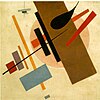
“New space neither needs nor demands pictures - it is not a picture transposed on a surface. This explains the painters' hostility towards us [a. o.: Malevich ]: we are destroying the wall as the resting place for their pictures.”
“This is the way in which the artist has set about the construction of the world - an activity which affects every human being and carries work beyond the frontiers of comprehension. We see how its creative path took it by way of cubism to pure construction, but there was still no outlet to be found here.”
“Therefore THE IDEA OF 'ARTISTIC WORK' MUST BE ABOLISHED AS A COUNTER-REVOLUTIONARY CONCEPT OF WHAT IS CREATIVE and work must be accepted as one of the functions of the living human organism in the same way as the beating of the heart or the activity of the nerve centers, so that it will be afforded the same protection.”

“..into this chaos [after the Bolshevik' revolution] came suprematism extolling the square [referring to the Squares of Malevich] as the very source of all creative expression, and then came communism and extolled work as the true source of man's heartbeat.”
“From the beginning of the [Sovjet] Revolution I was a member of the Committee for Art. Was commissioned for the first Soviet flag for the First of May 1918, which was carried across Red Square by members of the government. Later I worked at 'Izo Narkomprosa'. From 1919 I taught at the Higher Artists' Workshops in Vitebsk (our students Suetin, Judin and others).”
“We have named PROUN [the art, stepping over from painting to architecture] a station on the path to the construction of the new form.. .From being a simple depicter the artist becomes a creator (builder) of forms for a new world — the world of objectivity. This does not mean the creation of a rivalry with the engineer. Art has not yet crossed paths with science.”

“I was born on 23 November 1890 in a village in the province of Smolensk. Grew up in Smolensk, in the home of my grandfather, a cap-maker. Completed secondary school there. At the age of 15 I started earning money by giving drawing lessons. Passed the entrance examination of the art academy in Leningrad but, being a Jew, was not admitted due to the restricted percentage.”
“The path of the PROUN does not lie within the narrowly limited, fragmented, and isolated scientific disciplines — the builder consolidates them all together in his own experimental investigation. The path of the PROUN is not the incoherent approach of separate scientific disciplines, theories, and systems, but is rather the straightforward path of learned influence over reality.”

“[I] Went to Germany to study there and graduated from the architecture faculty in Darmstadt in 1914. I studied art during my trips through Europe; went to Paris. In the summer of 1912 I traveled more than 1200 km in Italy on foot, learning and drawing. In 1912 my works were accepted for the first time at the large exhibition in Petersburg. From 1915 in I lived in Moscow, exhibiting each year.”
“Back in Moscow in 1925 - teacher at 'Vchutemas' of interior design and furniture at the faculty of wood and metalwork. In 1926 my most important artistic work began: designing exhibitions. In that year I was invited by the committee of the International Exhibition of Art in Dresden to design the space for contemporary art. Was sent abroad for by 'VOKS'. [In] 1927 Exhibition of Typography in Moscow.”
“This dynamic architecture provides us with the new theater of life and because we are capable of grasping the idea of a whole town at any moment with any plan the task of architecture - the rhythmic arrangement of space and time - is perfectly and simply fulfilled for the new town will not be as chaotically laid out as the modern towns of north and south America but clearly and logically like a beehive..”
“Painting.. ..turned to the design of purely abstract volumetric forms.. .Since the leading exponent of the color theory was a painter (Malevich), he failed to recognize the objective reality of the world [in architecture!]. Because he always looked at it only through his own eyes, he remained trapped in a world devoid of real objects. The broader implications of this had to be developed by us, the architects.”
“PROUN alters the conventional forms of the arts and leaves behind the image of the petty individualist, who locked himself in his office and hid seated before a drawing easel, starting one picture and finishing another.
The future life — this is the reinforced concrete slab for the communist foundation of the nations of the entire world. With the aid of the PROUN one can build a unified city-commune on that foundation, intended for the life of all mankind.”
The future life — this is the reinforced concrete slab for the communist foundation of the nations of the entire world. With the aid of the PROUN one can build a unified city-commune on that foundation, intended for the life of all mankind.”
“We have had enough perpetually hearing MACHINE MACHINE MACHINE MACHINE. In the repetition of the word MACHINE, we read the modern artist's ambivalent relationship to mechanical reproduction: on the one hand, the rigorous linear order and uniform application of ink presented by the thrice-repeated type written line celebrates sterility; and on the other hand the content of the sentence itself bemoans the transformation of the industrial paradigm into an aesthetic cliché.”
“And amid the thunderous roar of a world in collision WE, ON THE LAST STAGE OF THE PATH TO SUPREMATISM BLASTED ASIDE THE OLD WORK OF ART LIKE A BEING OF FLESH AND BLOOD AND TURNED IT INTO A WORLD FLOATING IN SPACE. WE CARRIED BOTH PICTURE AND VIEWER OUT BEYOND THE CONFINES OF THIS SPHERE AND IN ORDER TO COMPREHEND IT FULLY THE VIEWER MUST CIRCLE LIKE A PLANET ROUND THE PICTURE WHICH REMAINS IMMOBILE IN THE CENTER. The empty phrase 'art for art's sake' had already been wiped out.”
Quotes About El Lissitsky
Gain deeper perspective through quotes about El Lissitsky from others.
Quote of Kazimir Malevich on El Lissitsky
“Lazar Markovich [Lissitsky], I salute you on the publication of this little book.”
Jacob Bendien on El Lissitsky 2 quotes
“[El] Lissitzky does exclaim 'Schafft Gegenstande' [Make Things]. But by this he does not mean real things.. .But why 'Gegenstande [Things]'? He only wants to make pseudo-things which express his urge for reality, for the earth. Things of the same hardness, immovability, earthbound in the same way as the daily life he sees around him.”
Quote of Theo van Doesburg on El Lissitsky
“But the projects with which the architects of Russian proletarian architecture present us are not only based on pure imagination, but their construction would, if they were fitted for realization, entail enormous waste of space and materials. The dwelling complex 'Wolkenbügel' [designed by Lissitzky, with the help of Emil Roth - Swiss architect, 1924] (assuming that one could live here without either freezing or melting!), shaped like a 4, stands in a very un-constructive way on three legs in which the elevators are located. The latter take up as much space as would one or more skyscrapers. And these 'architects' are to teach the West what architecture is!”
Quote of his wife on El Lissitsky
“There were tasks of a special kind awaiting him. He was needed in his homeland; the Soviet Union needed all his [Lissitzky's] knowledge, his experience, his art.”
Quote of Paul Wood on El Lissitsky
“Lissitzky was at first able to sustain a radical suspension of alternatives, to destabilize the spectator's spatial assumptions - as analogues for social assumptions - without replacing them with ready-made solutions; but that, as the dictatorship [of Stalinism ] grew in power, it overwhelmed this fragile possibility and inserted its own new/old closures into the sphere of graphic and ideological work alike. As long as Lissitzky kept intact the Utopian force of his (political) desire the radical project was sustainable; but as soon as the circumstances closed off his Utopian impulse, he was faced with no possibilities other than silence or service.”
About El Lissitsky
Lazar Markovich Lissitzky Лазарь Маркович Лисицкий (November 23, 1890 – December 30, 1941), more famous as El Lissitzky Эль Лисицкий, was a Russian artist, designer, photographer, teacher, typographer, and architect. He was an active protagonist of Russian Constructivism.