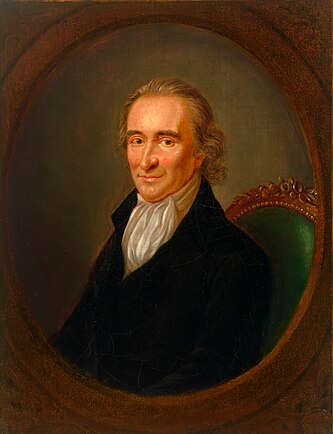
[T]he Rights of Man is a foundation-text of the English working-class movement... Paine speaks for the governed, and assumes that the authority of government derives from conquest and inherited power in a class-based society... What he gave to the people was a new rhetoric of radical egalitarianism, which touched the deepest responses of the ‘free-born Englishman’ and which penetrated the sub-political attitude of the urban working people... [T]he Paine tradition runs strongly through the popular journalism of the nineteenth century... It is strongly challenged in the 1880s, but the tradition and the rhetoric are still alive in Blatchford and in the popular appeal of Lloyd George. We can almost say that Paine established a new framework within which Radicalism was confined for nearly 100 years.
What It Means
This is a placeholder explanation generated by the low-overhead model. It interprets "[T]he Rights of Man is a foundation-text of the English working-class movement... Paine speaks for the governed, and assumes that the authority of government derives from conquest and inherited power in a class-based society... What he gave to the people was a new rhetoric of radical egalitarianism, which touched the deepest responses of the ‘free-born Englishman’ and which penetrated the sub-political attitude of the urban working people... [T]he Paine tradition runs strongly through the popular journalism of the nineteenth century... It is strongly challenged in the 1880s, but the tradition and the rhetoric are still alive in Blatchford and in the popular appeal of Lloyd George. We can almost say that Paine established a new framework within which Radicalism was confined for nearly 100 years." in the context of "E. P. Thompson, The Making of the English Working Class (1963; rev. edn. 1968), pp. 99–100, 103" to mean that wisdom is timeless.
Tags

About E. P. Thompson