Link Copied!
Dexter S. Kimball Quotes (1865-1952)
President, Actor, Author



About Dexter S. Kimball
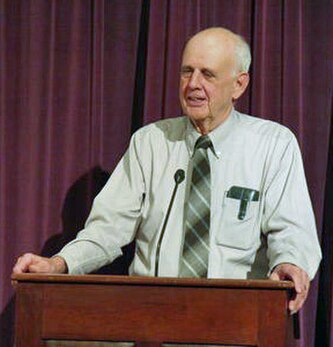
Dexter Simpson Kimball (Oct. 21, 1865 - Nov. 1, 1952) was an American engineer, Professor of Industrial Engineering at Cornell University, early management author and President of the American Society of Mechanical Engineers in 1922-23.
Best Dexter S. Kimball Quotes
Shortest
Earliest
Explore our curated collection of the most famous and impactful Dexter S. Kimball quotes.
“The underlying principle of specialization is division of labor; but the term division of labor has become associated with the individual worker, whereas specialization is, in general, far reaching in its effects, and influences industrial enterprises of all kinds.”
“There is another and very important ground for standardization and that is the desirability of having parts interchangeable. Standards of exchange have long been in general use, and these have, most usually, been fixed with a view to convenient use rather than on a scientific basis. The units of weight and measure are examples of this form of standard. They may not even be the most logical, or most convenient, but once established they can, in general, be changed only by slow degrees, if at all.”
“It is human experience that as a man concentrates his efforts, either mental or manual, his skill in his chosen specialty, and the quantity of his product increase. It was shown... that specialization in machinery had a powerful influence in specializing the workman and thereby extending the principle of division of labor. But division of labor may be furthered by other influences. The very growth of all lines of human knowledge and activity makes it increasingly difficult for one man to retain a grasp of any one entire field. He must be content to cultivate a small portion of it.”

“By standardization is meant the reduction of any one line to fixed types and sizes. Thus in the case of the manufacturer of shoes he selects a few types that, in his opinion, will find favor in the market. But each foot is not measured and a shoe of the required type made to these measurements. A limited number of sizes of each type is manufactured, these sizes being selected, by previous experience, so that any average man can find a pair that will fit him. The same holds true for the case of electric motors discussed above, and in fact for the entire field of manufactured products.”
“The new industrial methods have greatly accelerated certain tendencies that had already manifested themselves in the old domestic factories and some of these deserve more than passing notice as they are affecting not only productive processes but our social organization as well. Perhaps the most important of these influences are those that tend toward
(1) Aggregation or increase in size of industrial enterprises.
(2) Specialization or the limiting of the field of activity, not only of enterprises but also of men.
(3) Standardization or the reduction of all lines of product to a limited number of types and sizes.
(4) Extreme division of labor, following aggregation, specialization, and standardization and requiring special consideration.
These tendencies are all closely interlocked with each other, and with modern productive methods. It will be clearer, however, to discuss them separately before summing up their joint action.”
“Specialization, as has been noted, is the confining of human activity to a limited field. In industrial work this means the limitation of an enterprise to a portion of the field and to the production of a limited line of products. But even when the line of products is limited, there are usually many types that are possible in that line and an infinite number of sizes of any one type. Thus suppose a manufacturer specializes in the manufacture of men's shoes. Here there is no limit to the types that may be produced and no limit to the number of sizes of any type since no two feet are exactly alike. Again a manufacturer may specialize on the production of motors between the sizes, say, of one-half horse-power and twenty horse-power. Here again many types are possible and an infinite number of sizes for each type. But it has been shown that one of the essentials of cheap production is quantity, and for a given total output the greatest number of each element entering into the product is secured when the numbers of types and sizes are a minimum.”
“The term division of labor has, from long usage, become associated in the public mind with manual processes. But productive labor is, in general, both manual and mental and just as there may be division of manual labor so there may be division of mental labor or division of thought. Modern productive methods tend constantly to separate mental labor from manual labor and then to subdivide each into smaller and smaller parts. The subdivision of manual labor is greatly furthered, as has been seen, by the extended use of tools. Subdivision of mental labor on the other hand is hastened by an increase in the amount of knowledge and mental development necessary to successfully perform the work in hand. Thus the mental labor of designing machinery is performed largely apart from the actual production; and this mental labor has become very closely specialized as the scientific basis of engineering has grown. This process of subdivision is greatly hastened in both manual and mental operations by increased quantity since this, of itself, enables the manager to avail himself of the inherent advantages of division of labor already discussed.”
Dexter S. Kimball Quotes by Topic
Find exactly what you are looking for by browsing this categorized list of Dexter S. Kimball quotes by topic.
Dexter S. Kimball on Division of labor 2 quotes
“The underlying principle of specialization is division of labor; but the term division of labor has become associated with the individual worker, whereas specialization is, in general, far reaching in its effects, and influences industrial enterprises of all kinds.”

Dexter S. Kimball on Specialization
“The underlying principle of specialization is division of labor; but the term division of labor has become associated with the individual worker, whereas specialization is, in general, far reaching in its effects, and influences industrial enterprises of all kinds.”
Dexter S. Kimball on Organization
“The new industrial methods have greatly accelerated certain tendencies that had already manifested themselves in the old domestic factories and some of these deserve more than passing notice as they are affecting not only productive processes but our social organization as well. Perhaps the most important of these influences are those that tend toward
(1) Aggregation or increase in size of industrial enterprises.
(2) Specialization or the limiting of the field of activity, not only of enterprises but also of men.
(3) Standardization or the reduction of all lines of product to a limited number of types and sizes.
(4) Extreme division of labor, following aggregation, specialization, and standardization and requiring special consideration.
These tendencies are all closely interlocked with each other, and with modern productive methods. It will be clearer, however, to discuss them separately before summing up their joint action.”

Dexter S. Kimball on Knowledge worker
“The term division of labor has, from long usage, become associated in the public mind with manual processes. But productive labor is, in general, both manual and mental and just as there may be division of manual labor so there may be division of mental labor or division of thought. Modern productive methods tend constantly to separate mental labor from manual labor and then to subdivide each into smaller and smaller parts. The subdivision of manual labor is greatly furthered, as has been seen, by the extended use of tools. Subdivision of mental labor on the other hand is hastened by an increase in the amount of knowledge and mental development necessary to successfully perform the work in hand. Thus the mental labor of designing machinery is performed largely apart from the actual production; and this mental labor has become very closely specialized as the scientific basis of engineering has grown. This process of subdivision is greatly hastened in both manual and mental operations by increased quantity since this, of itself, enables the manager to avail himself of the inherent advantages of division of labor already discussed.”
Quotes About Dexter S. Kimball
Gain deeper perspective through quotes about Dexter S. Kimball from others.
Cornell Society of Engineers on Dexter S. Kimball
“We are proud of Dean Kimball’s national fame as an engineer and leader in engineering education: we are mindful of his outstanding professional achievements which have contributed to the prestige of our College. Yet, in the intimacy of this Cornell group, our main desire is to record our respect and affection for one who in the discharge of his duties has evinced qualities of gentle humanity and gracious friendship adorning his technical skill and attainments.
He has done perhaps his most important work for education in two fields, as Dean of the College of Engineering and as writer of successful books in a newly opened and most important field.
By the breadth of his intellectual interests and by his literary and artistic knowledge and sympathies, he has set a lofty standard for his fellow engineers who wish to add to their scientific accomplishments something of his maturity and richness of understanding of the finer things of life.”
C. D. Albert on Dexter S. Kimball
“A full account of his life would read like a typical American success story of a career during the post-war years of rapid industrialization and mechanization.”
About Dexter S. Kimball
Dexter Simpson Kimball (Oct. 21, 1865 - Nov. 1, 1952) was an American engineer, Professor of Industrial Engineering at Cornell University, early management author and President of the American Society of Mechanical Engineers in 1922-23.