Link Copied!
Carl Friedrich Gauss Quotes (1777-1855)
Physicist, Mathematician
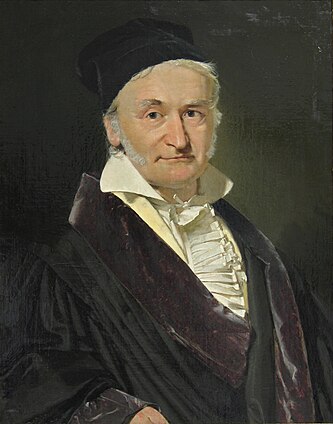
About Carl Friedrich Gauss
Johann Carl Friedrich Gauss (30 April 1777 – 23 February 1855) was a German mathematician, astronomer and physicist.
Best Carl Friedrich Gauss Quotes
Shortest
Earliest
Explore our curated collection of the most famous and impactful Carl Friedrich Gauss quotes.
“Mathematics is the queen of the sciences.”


“Yes! The world would be nonsense, the whole creation an absurdity without immortality.”

“[

“The study of Euler's works will remain the best school for the different fields of mathematics and nothing else can replace it.”
“Less depends upon the choice of words than upon this, that their introduction shall be justified by pregnant theorems.”
“If others would but reflect on mathematical truths as deeply and as continuously as I have, they would make my discoveries.”
“All the measurements in the world do not balance one theorem by which the science of eternal truths is actually advanced.”
“We must admit with humility that, while number is purely a product of our minds, space has a reality outside our minds, so that we cannot completely prescribe its properties a priori.”
“To praise it would amount to praising myself. For the entire content of the work … coincides almost exactly with my own meditations which have occupied my mind for the past thirty or thirty-five years.”


“I confess that Fermat's Theorem as an isolated proposition has very little interest for me, because I could easily lay down a multitude of such propositions, which one could neither prove nor dispose of.”
“I mean the word proof not in the sense of the lawyers, who set two half proofs equal to a whole one, but in the sense of a mathematician, where ½ proof = 0, and it is demanded for proof that every doubt becomes impossible.”
“I am coming more and more to the conviction that the necessity of our geometry cannot be demonstrated, at least neither by, nor for, the human intellect. . . Geometry should be ranked, not with arithmetic, which is purely aprioristic, but with mechanics.”

“I scarcely believe that in psychology data are present which can be mathematically evaluated. But one cannot know this with certainty, without having made the experiment. God alone is in possession of the mathematical bases of psychic phenomena.”
“If the object of all human investigation were but to produce in cognition a reflection of the world as it exists, of what value would be all its labor and pains, which could result only in vain repetition, in an imitation within the soul of that which exists without it?”

“One is forced to the view, for which there is so much evidence even though without rigorous scientific basis, that besides this material world another, second, purely spiritual world order exists, with just as many diversities as that in which we live-—we are to participate in it.”

“One day he said: For the soul there is a satisfaction of a higher type; the material is not at all necessary. Whether I apply mathematics to a couple of clods of dirt, which we call planets, or to purely arithmetical problems, it's just the same; the latter have only a higher charm for me.”
Carl Friedrich Gauss Quotes by Topic
Find exactly what you are looking for by browsing this categorized list of Carl Friedrich Gauss quotes by topic.
Carl Friedrich Gauss on Arithmetic 5 quotes
“But in our opinion truths of this kind should be drawn from notions rather than from notations.”
Carl Friedrich Gauss on Foundations of mathematics 3 quotes
“The ease with which you have assimilated my notions of geometry has been a source of genuine delight to me, especially as so few possess a natural bent for them. I am profoundly convinced that the theory of space occupies an entirely different position with regard to our knowledge a priori from that of the theory of numbers (Grössenlehre); that perfect conviction of the necessity and therefore the absolute truth which is characteristic of the latter is totally wanting to our knowledge of the former. We must confess in all humility that a number is solely a product of our mind. Space, on the other hand, possesses also a reality outside of our mind, the laws of which we cannot fully prescribe a priori.”
Carl Friedrich Gauss on Truth 2 quotes
“The way I have taken seems not to lead to the goal, but much rather to make the truth of geometry doubtful.”
Carl Friedrich Gauss on Geometry
Carl Friedrich Gauss on Mathematics
“...[A]ll the measurements in the world do not balance one theorem by which the science of eternal truths is actually advanced.”
Carl Friedrich Gauss on Number theory
“Mathematics is the queen of the sciences and number theory is the queen of mathematics. She often condescends to render service to astronomy and other natural sciences, but in all relations she is entitled to the first rank.”

Carl Friedrich Gauss on Prime number
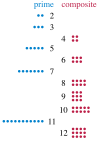
“The problem of distinguishing prime numbers from composite numbers and of resolving the latter into their prime factors is known to be one of the most important and useful in arithmetic. It has engaged the industry and wisdom of ancient and modern geometers to such an extent that it would be superfluous to discuss the problem at length. … Further, the dignity of the science itself seems to require that every possible means be explored for the solution of a problem so elegant and so celebrated.”
Carl Friedrich Gauss on Knowledge
“It is not knowledge, but the act of learning, not possession but the act of getting there, which grants the greatest enjoyment. When I have clarified and exhausted a subject, then I turn away from it, in order to go into darkness again; The never-satisfied man is so strange—if he has completed a structure, then it is not in order to dwell in it peacefully, but in order to begin another. I imagine the world conqueror must feel thus, who, after one kingdom is scarcely conquered, stretches out his arms again for others.”
Carl Friedrich Gauss on Learning
“It is not knowledge, but the act of learning, not possession but the act of getting there, which grants the greatest enjoyment. When I have clarified and exhausted a subject, then I turn away from it, in order to go into darkness again; The never-satisfied man is so strange—if he has completed a structure, then it is not in order to dwell in it peacefully, but in order to begin another. I imagine the world conqueror must feel thus, who, after one kingdom is scarcely conquered, stretches out his arms again for others.”

Carl Friedrich Gauss on Differential calculus
“In general the position as regards all such new calculi is this - That one cannot accomplish by them anything that could not be accomplished without them. However, the advantage is, that, provided such a calculus corresponds to the inmost nature of frequent needs, anyone who masters it thoroughly is able - without the unconscious inspiration of genius which no one can command - to solve the respective problems, yea to solve them mechanically in complicated cases in which, without such aid, even genius becomes powerless. Such is the case with the invention of general algebra, with the differential calculus, and in a more limited region with Lagrange's calculus of variations, with my calculus of congruences, and with Mobius's calculus. Such conceptions unite, as it were, into an organic whole countless problems which otherwise would remain isolated and require for their separate solution more or less application of inventive genius.”
Carl Friedrich Gauss on Calculus
“In general the position as regards all such new calculi is this — That one cannot accomplish by them anything that could not be accomplished without them. However, the advantage is, that, provided such a calculus corresponds to the inmost nature of frequent needs, anyone who masters it thoroughly is able — without the unconscious inspiration of genius which no one can command — to solve the respective problems, yea to solve them mechanically in complicated cases in which, without such aid, even genius becomes powerless. Such is the case with the invention of general algebra, with the differential calculus, and in a more limited region with Lagrange's calculus of variations, with my calculus of congruences, and with Mobius's calculus. Such conceptions unite, as it were, into an organic whole countless problems which otherwise would remain isolated and require for their separate solution more or less application of inventive genius.”

Carl Friedrich Gauss on Unification in science and mathematics
“In general the position as regards all such new calculi is this — That one cannot accomplish by them anything that could not be accomplished without them. However, the advantage is, that, provided such a calculus corresponds to the inmost nature of frequent needs, anyone who masters it thoroughly is able — without the unconscious inspiration of genius which no one can command — to solve the respective problems, yea to solve them mechanically in complicated cases in which, without such aid, even genius becomes powerless. Such is the case with the invention of general algebra, with the differential calculus, and in a more limited region with Lagrange's calculus of variations, with my calculus of congruences, and with Mobius's calculus. Such conceptions unite, as it were, into an organic whole countless problems which otherwise would remain isolated and require for their separate solution more or less application of inventive genius.”

Carl Friedrich Gauss on History of algebra
“In general the position as regards all such new calculi is this — That one cannot accomplish by them anything that could not be accomplished without them. However, the advantage is, that, provided such a calculus corresponds to the inmost nature of frequent needs, anyone who masters it thoroughly is able — without the unconscious inspiration of genius which no one can command — to solve the respective problems, yea to solve them mechanically in complicated cases in which, without such aid, even genius becomes powerless. Such is the case with the invention of general algebra, with the differential calculus, and in a more limited region with Lagrange's calculus of variations, with my calculus of congruences, and with Mobius's calculus. Such conceptions unite, as it were, into an organic whole countless problems which otherwise would remain isolated and require for their separate solution more or less application of inventive genius.”
Carl Friedrich Gauss on Negative number
“Our general arithmetic, so far surpassing in extent the geometry of the ancients, is entirely the creation of modern times. Starting originally from the notion of absolute integers, it has gradually enlarged its domain. To integers have been added fractions, to rational quantities the irrational, to positive the negative and to the real the imaginary. This advance, however, has always been made at first with timorous and hesitating step. The early algebraists called the negative roots of equations false roots, and these are indeed so when the problem to which they relate has been stated in such a form that the character of the quantity sought allows of no opposite. But just as in general arithmetic no one would hesitate to admit fractions, although there are so many countable things where a fraction has no meaning, so we ought not to deny to negative numbers the rights accorded to positive simply because innumerable things allow no opposite. The reality of negative numbers is sufficiently justified since in innumerable other cases they find an adequate substratum. This has long been admitted, but the imaginary quantities—formerly and occasionally now, though improperly, called impossible—as opposed to real quantities, are still rather tolerated than fully naturalized, and appear more like an empty play upon symbols to which a thinkable substratum is denied unhesitatingly by those who would not depreciate the rich contribution which this play upon symbols has made to the treasure of the relations of real quantities. The author has for many years considered this highly important part of mathematics from a different point of view, where just as objective an existence may be assigned to imaginary as to negative quantities, but hitherto he has lacked opportunity to publish these views. In the present paper the outlines are given briefly; they consist of the following: Positive and negative numbers can only find an application when the thing counted has an opposite which when conceived of as united with it has the effect of destroying it. Accurately speaking, this supposition can only be made where the things enumerated are not substances (objects thinkable in themselves) but relations between any two objects. It is postulated that these objects are arranged after a definite fashion in a series e.g., A, B, C, D,... and that the relation of A to B can be regarded as equal to that of B to C, etc. The notion of opposition involves nothing further than the interchange of the terms of the relation so that if the relation of (or transition from) A to B is considered as +1 the relation of B to A must be represented by -1. So far then as such a series is unlimited on both sides, every real integer represents the relation of a term arbitrarily taken as origin to a definite term of the series. If, however, the objects are of such a kind that they cannot be arranged in one series, even though unlimited, but only in series of series, or, what amounts to the same thing, they form a manifoldness of two dimensions; if there is the same connection between the relations of one series to another, or the transitions from one to another, as in the case of the transition from one term of a series to another term of the same series, we shall evidently need for the measurement of the transition from one term of the system to another, besides the previous units +1 and -1, two others opposite in character +i and -i. Obviously we must also postulate that the unit i shall always mark the transition from a given term of the one series to a definite term of the immediately adjacent series. In this way the system can be arranged in a two-fold manner in series of series. The mathematician leaves entirely out of consideration the nature of the objects and the content of their relations. He has simply to do with the enumeration and comparison of the relations. So far as he has assigned sameness of nature to the relations designated by +1 and -1, considered in themselves, he is warranted in extending such sameness to all four elements, +1, -1, +i, -i. ...We see further that if we wish to take +1 for the relation previously expressed by +i, we must necessarily take +i for the relation previously expressed by -1. In the language of mathematicians this means that +i is a mean proportional between +1 and -1, or corresponds to the symbol sqrt{-1}. We say purposely not the mean proportional because -i has just as good a right to that designation. Here then the demonstrability of an intuitive signification of sqrt{-1} has been fully justified and nothing more is necessary to bring this quantity into the domain of objects of arithmetic.”

What Carl Friedrich Gauss Said About Others
Discover personal opinions Carl Friedrich Gauss shared regarding contemporaries.
Carl Friedrich Gauss on Ferdinand Eisenstein
“There have been only three epoch-making mathematicians: Archimedes, Newton, and Eisenstein.”
Carl Friedrich Gauss on Georg Wilhelm Friedrich Hegel
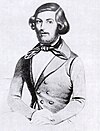
“Hegel's insania in the dissertation under question seems to be wisdom compared with his later ones.”
Carl Friedrich Gauss on Leonhard Euler
“The study of Euler's works will remain the best school for the different fields of mathematics and nothing else can replace it.”

Carl Friedrich Gauss on Isaac Newton
“The history of the apple is too absurd. Whether the apple fell or not, how can any one believe that such a discovery could in that way be accelerated or retarded? Undoubtedly, the occurrence was something of this sort. There comes to Newton a stupid, importunate man, who asks him how he hit upon his great discovery. When Newton had convinced himself what a noodle he had to do with, and wanted to get rid of the man, he told him that an apple fell on his nose; and this made the matter quite clear to the man, and he went away satisfied.”

Carl Friedrich Gauss on Immanuel Kant
“I am almost amazed that you consider a professional philosopher capable of no confusion in concepts and definitions. Such things are nowhere more at home than among philosophers who are not mathematicians, and Wolff was no mathematician, even though he made cheap compen- diums. Look around among the philosophers of today, among Schelling, Hegel, Nees von Esenbeck, and their like; doesn't your hair stand on end at their definitions? Read in the history of ancient philosophy what kinds of definitions the men of that day, Plato and others, gave (I except Aristotle). But even in Kant it is often not much better; in my opinion his distinction between analytic and synthetic theorems is such a one that either peters out in a triviality or is false.”

Quotes About Carl Friedrich Gauss
Gain deeper perspective through quotes about Carl Friedrich Gauss from others.
Florian Cajori on Carl Friedrich Gauss
“Some of the discoveries of Abel and Jacobi were anticipated by Gauss. In the Disquisitiones Arithmeticæ he observed that the principles which he used in the division of the circle were applicable to many other functions, besides the circular, and particularly to the transcendents dependent on the integral displaystyle int frac{,dx}{sqrt{1-x^4}}. From this Jacobi concluded that Gauss had thirty years earlier considered the nature and properties of elliptic functions and had discovered their double periodicity. The papers in the collected works of Gauss confirm this conclusion.”

Sometimes attributed on Carl Friedrich Gauss
August Leopold Crelle on Carl Friedrich Gauss
“Everything Gauss writes is abomination, as it is so obscure that it is almost impossible to understand it.”
Albert Einstein on Carl Friedrich Gauss
Morris Kline on Carl Friedrich Gauss 2 quotes
“There is no doubt... that mathematicians are generally overzealous about conciseness, and in their passion for brevity indulge in symbols even where these seem no better than a familiar English word or phrase. A faulty judgement has caused mathematicians to equate elegance and conciseness at the cost of intelligibility. Gauss himself wrote elegant, but highly compact, carefully polished papers with no hint of the motivation, meaning, or details of the steps. When criticized, he said that no architect leaves the scaffolding after completing the building. But the fact is that even excellent mathematicians found the reading of Gauss's papers very difficult, and the same is true of many other mathematicians.”
They asked Laplace who on Carl Friedrich Gauss
“On demandait à Laplace quel était selon lui le plus grand mathématicien de l'Allemagne. C'est Pfaff, répondit-il. - Je croyais, reprit l'interlocuteur, que Gauss lui était supérieur. - Mais, s'écria Laplace, vous me demandez quel est le plus grand mathématicien de l'Allemagne, et Gauss est le plus grand mathématicien de l'Europe.”
James Clerk Maxwell on Carl Friedrich Gauss
“It is to Gauss, to the Magnetic Union, and to magnetic observers in general, that we owe our deliverance from that absurd method of estimating forces by a variable standard which prevailed so long even among men of science. It was Gauss who first based the practical measurement of magnetic force (and therefore of every other force) on those long established principles, which, though they are embodied in every dynamical equation, have been so generally set aside, that these very equations, though correctly given... are usually explained... by assuming, in addition to the variable standard of force, a variable, and therefore illegal, standard of mass.”

Marvin Minsky on Carl Friedrich Gauss
“If explaining minds seems harder than explaining songs, we should remember that sometimes enlarging problems makes them simpler! The theory of the roots of equations seemed hard for centuries within its little world of real numbers, but it suddenly seemed simple once Gauss exposed the larger world of so-called complex numbers. Similarly, music should make more sense once seen through listeners' minds.”

Wolfgang Sartorius von Waltershausen on Carl Friedrich Gauss
“According to his frequently expressed view, Gauss considered the three dimensions of space as specific peculiarities of the human soul; people, which are unable to comprehend this, he designated in his humorous mood by the name Bœotians. We could imagine ourselves, he said, as beings which are conscious of but two dimensions; higher beings might look at us in a like manner, and continuing jokingly, he said that he had laid aside certain problems which, when in a higher state of being, he hoped to investigate geometrically.”
Source on Carl Friedrich Gauss 4 quotes
“Gauss liked to call [number theory] 'the Queen of Mathematics'. For Gauss, the jewels in the crown were the primes, numbers which had fascinated and teased generations of mathematicians.”
About Carl Friedrich Gauss
Johann Carl Friedrich Gauss (30 April 1777 – 23 February 1855) was a German mathematician, astronomer and physicist.