Link Copied!
C. Wright Mills Quotes (1916-1962)
Author

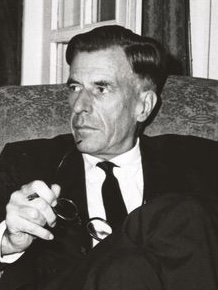









About C. Wright Mills
C. Wright Mills (August 28, 1916 – March 20, 1962) was an American sociologist, best remembered for studying the structure of power in the U.S. in his book The Power Elite. Mills was concerned with the responsibilities of intellectuals in post-World War II society. He advocated relevance and engagement over disinterested academic observation as a "public intelligence apparatus" in challenging the policies of the institutional elites in the "Three" (the economic, political and military).
Best C. Wright Mills Quotes
Shortest
Earliest
Explore our curated collection of the most famous and impactful C. Wright Mills quotes.
“IBM Plus Reality Plus Humanism=Sociology”


“[A]s a proportion of the labor force, fewer individuals manipulate things, more handle people and symbols.”
“When ever the standards of the moneyed life prevail, the man with money, no matter how he got it, will eventually be respected.”
“[O]ne could translate the 555 pages of The Social System into about 150 pages of straightforward English. The result would not be very impressive.”
“Here's to the day when the complete works of Leon Trotsky are published and widely distributed in the Soviet Union. On that day the USSR will have achieved democracy!”



“Every revolution has its counterrevolution — that is a sign the revolution is for real. And every revolution must defend itself against this counterrevolution, or the revolution will fail.”
“If you do not specify and confront real issues, what you say will surely obscure them. If you do not embody controversy, what you say will be an acceptance of the drift to the coming human hell.”

“The first rule for understanding the human condition is that men live in second-hand worlds. They are aware of much more than they have personally experienced; and their own experience is always indirect.”

“The market is sovereign and in the magic economy of the small entrepreneur there is no authoritarian center… in the political sphere… the equilibrium of powers prevails, and hence there is no chance of despotism.”

“An expensive arms race, under cover of the military metaphysic, and in a paranoid atmosphere of fright, is an economically attractive business. To many utopian capitalists, it has become the Business Way of American Life."”

“It is not characteristic of American executives to read books, except books on 'management' and mysteries. ... Those who who do venture into this arena ... are looked upon by their colleagues with mingled awe and incredulity.”
“For the first time in American history, men in authority are talking about an 'emergency' without a foreseeable end,...Such men as these are crackpot realists: in the name of realism they have constructed a paranoid reality all their own.”
“Moral distrust of men in public life is an old American convention. In the current campaign, however, it has reached unprecedented heights: each of the leading candidates has felt it necessary to make public an accounting of his personal income.”
“If we accept the Greek's definition of the idiot as an altogether private man, then we must conclude that many American citizens are now idiots. And I should not be surprised, although I don't know, if there were some such idiots even in Germany.”

“The truth about the nature and the power of the elite is not some secret which men of affairs know but will not tell. ... No matter how great their actual power, they tend to be less acutely aware of it than of the resistance of others to its use.”

“In the formulas of 'personnel experts', men and women are to be shaped into the 'well rounded, acceptable, effective personality.' Just like small proprietors, they cannot higgle over prices, which are fixed, or 'judge the market' and accordingly buy wisely.”

“Kindness and friendliness become aspects of personalized service or of public relations of big firms, rationalized to further the sale of something. With anonymous insincerity, the Successful Person thus makes an instrument of his own appearance and personality.”

“Some men want war for sordid, others for idealistic, reasons; some for personal gain, others for impersonal principle. But most of those who consciously want war and accept it, and so help to create its "inevitability," want it in order to shift the locus of their problems.”
C. Wright Mills Quotes by Topic
Find exactly what you are looking for by browsing this categorized list of C. Wright Mills quotes by topic.
C. Wright Mills on Ideology 3 quotes
“As public communications are expanded and speeded up, their effectiveness is worn out by repetition; so there is a continuous demand for new slogans and beliefs and ideologies.”
C. Wright Mills on United States 3 quotes
“The American elite does not have any real image of peace — other than as an uneasy interlude existing precariously by virtue of the balance of mutual fright. The only seriously accepted plan for peace is the full loaded pistol. In short, war or a high state of war-preparedness is felt to be the normal and seemingly permanent condition of the United States.”

C. Wright Mills on War and peace 3 quotes
“The American elite does not have any real image of peace — other than as an uneasy interlude existing precariously by virtue of the balance of mutual fright. The only seriously accepted plan for peace is the full loaded pistol. In short, war or a high state of war-preparedness is felt to be the normal and seemingly permanent condition of the United States.”
C. Wright Mills on Military 3 quotes
“For the corporation executives, the military metaphysic often coincides with their interest in a stable and planned flow of profit; it enables them to have their risk underwritten by public money; it enables them reasonably to expect that they can exploit for private profit now and later, the risky research developments paid for by public money. It is, in brief, a mask of the subsidized capitalism from which they extract profit and upon which their power is based.”

C. Wright Mills on Academia
C. Wright Mills on Indignation
“Atrocity on a mass scale has become impersonal and official; moral indignation as a public fact has become extinct or made trivial.”

C. Wright Mills on Competition
“Nobody talks more of free enterprise and competition and of the best man winning than the man who inherited his father's store or farm.”

C. Wright Mills on Laissez-faire
“Nobody talks more of free enterprise and competition and of the best man winning than the man who inherited his father's store or farm.”

C. Wright Mills on Public relations
C. Wright Mills on Business
C. Wright Mills on Autonomy
“The mass has no autonomy from institutions; on the contrary, agents of authorized institutions penetrate this mass, reducing any autonomy it may have in the formation of opinion by discussion.”

C. Wright Mills on Elitism
“People with advantages ... come readily to define themselves as inherently worthy of what they possess; they come to believe themselves 'naturally' elite, and, in fact, to imagine their possessions and their privileges as natural extensions of their own elite selves.”

What C. Wright Mills Said About Others
Discover personal opinions C. Wright Mills shared regarding contemporaries.
C. Wright Mills on John Kenneth Galbraith
C. Wright Mills on Leon Trotsky
“Here's to the day when the complete works of Leon Trotsky are published and widely distributed in the Soviet Union. On that day the USSR will have achieved democracy!”
C. Wright Mills on Thorstein Veblen
“Veblen ... was a masterless, recalcitrant man, and if we must group him somewhere in the American scene, it is with those most recalcitrant Americans, the Wobblies. On the edges of the higher learning, Veblen tried to live like a Wobbly. It was a strange place for such an attempt. The Wobblies were not learned, but they were, like Veblen, masterless men, and the only non-middle class movement of revolt in twentieth-century America. With his acute discontent and shyness of program Veblen was a sort of intellectual Wobbly.”

Quotes About C. Wright Mills
Gain deeper perspective through quotes about C. Wright Mills from others.
Hannah Arendt on C. Wright Mills
“"All politics is a struggle for power; the ultimate kind of power is violence," said C. Wright Mills, echoing, as it were, Max Weber's definition of the state as "the rule of men over men based on the means of legitimate, that is allegedly legitimate, violence." The consensus is very strange; for to equate political power with "the organization of violence" makes sense only if one follows Marx's estimate of the state as an instrument of oppression in the hands of the ruling class.”

Annette Lareau Unequal Childhoods on C. Wright Mills
“In The Sociological Imagination, Mills stresses the importance of institutions: "Much of human life consists of playing... roles within specific institutions. To understand the biography of an individual, we must understand the significance and meaning of the roles he has played and does play; to understand these roles we must understand the institutions of which they are a part."”
About C. Wright Mills
C. Wright Mills (August 28, 1916 – March 20, 1962) was an American sociologist, best remembered for studying the structure of power in the U.S. in his book The Power Elite. Mills was concerned with the responsibilities of intellectuals in post-World War II society. He advocated relevance and engagement over disinterested academic observation as a "public intelligence apparatus" in challenging the policies of the institutional elites in the "Three" (the economic, political and military).