Link Copied!
Babur Quotes (1483-1530)
Emperor, Poet


About Babur
Zahir-ud-Din Muhammad Babur or Babur (February 14, 1483 – December 26, 1530) was a descendant of Genghis Khan and Timur; Babur was a military adventurer, a soldier of distinction, a poet, diarist and statesman. Babur was the first Mughal Emperor and founder of the Mughal Empire.
Best Babur Quotes
Shortest
Earliest
Explore our curated collection of the most famous and impactful Babur quotes.
“Baburnama, Translated by S.A.A. Rizvi included in Mughal Kãlîna Bhãrata: Bãbur, Aligarh, 1960, p. 167”
““In many parts of the plains thorny jungles grow, behind the good defence of which the people… become stubbornly rebellious… and pay no taxes.””
“Professor Sri Ram Sharma cites from Tãrîkh-i-Bãburî that “His Sadr, Shaikh Zain, demolished many Hindu temples at Chanderî when he occupied it”.”
“Most of the inhabitants of Hindustan are pagans ; they call a pagan a Hindu. Most Hindus believe in the transmigration of souls. All artisans, wage-earners, and officials are Hindus.”
“In AH 934 (AD 1528), I attacked Chanderî and, by the grace of Allãh, captured it in a few hours… We got the infidels slaughtered and the place which had been a dãru’l-harb for years, was made into a dãru’l-Islãm.”
“There are two trade marts on the land route between Hindustan and Khurasan; one is Kabul, the other, Qandhar... from Hindustan, come every year caravans... bringing slaves (barda) and other commodities, and sell them at great profit.”
“Chandiri I stormed in 934 A.H. (1528 A.D.) and, by God's pleasure, took it in a few hours; in it was Rana Sanga's great and trusted man Midni Rao, we made general massacre of the Pagans in it and, as will be narrated, converted what for many years had been a mansion of hostility, into a mansion of Islam.”

“'After this success, Ghazi (Victor in a Holy-war) was written amongst the royal titles. Below the titles (tughra) entered on the Fath-nama, I wrote the following quatrain:
For Islam's sake, I wandered in the wilds,
Prepared for war with pagans and Hindus,
Resolved myself to meet the martyr's death,
Thanks be to Allah! a ghazi I became.”
For Islam's sake, I wandered in the wilds,
Prepared for war with pagans and Hindus,
Resolved myself to meet the martyr's death,
Thanks be to Allah! a ghazi I became.”
“Hindustan is a country which has few pleasures to recommend it.... Indians have no idea of the charms of friendly society, of frankly mixing together, or of familiar intercourse.... They have no horses, no good grapes, or musk melons, no good fruits, no ice or cold water, no good food or bread in their bazaars, no bath or colleges, no candles, no torches, not a candle stick”
“[Hindustan] is a wonderful country. Compared with our countries it is a different world ; its mountains, rivers, jungles and deserts, its towns, its cultivated lands, its animals and plants, its peoples and their tongues, its rains, and its winds, are all different. ...Once the water of Sind is crossed, everything is in the Hindustan way, land, water, tree, rock, people and horde, opinion and custom.”

“I made public the resolution to abstain from wine, which had been hidden in the treasury of my breast The victorious servants, in accordance with the illustrious order, dashed upon the earth of contempt and destruction the flagons and the cups, and the other utensils in gold and silver, which in their number and their brilliance were like the stars of the firmament They dashed them in pieces, as, God willing! soon will be dashed the gods of the idolaters, - and they distributed the fragments among the poor and needy.”

“I have not written all this to complain: I have simply written the truth. I do not intend by what I have written to compliment myself: I have simply set down exactly what happened. Since I have made it a point in this history to write the truth of every matter and to set down no more than the reality of every event, as a consequence I have reported every good and evil I have seen of father and brother and set down the actuality of every fault and virtue of relative and stranger. May the reader excuse me; may the listener take me not to task.”
“'And victory the beautiful woman (shahid) whose world-adornment of waving tresses was embellished by Allah will aid you with a mighty aid, bestowed on us the good fortune that had been hidden behind a veil, and made it a reality. The absurd (batil) Hindus, knowing their position perilous, dispersed like carded wool before the wind, and like moths scattered abroad. Many fell dead on the field of battle; others, desisting from fighting, fled to the desert exile and became the food of crows and kites. Mounds were made of the bodies of the slain, pillars of their heads.”

“'Next day, at the time of the noon prayer, we went out for seeing those places in Gwalior which we had not yet seen' Going out of the Hathipole Gate of the fort, we arrived at a place called Urwa'...'Solid rocks surround Urwa on three sides' On these sides people have carved statues in stone. They are in all sizes, small and big. A very big statue, which is on the southern side, is perhaps 20 yards high. These statues are altogether naked and even their private parts are not covered'...'Urwa is not a bad place. It is an enclosed space. Its biggest blemish is its statues. I ordered that they should be destroyed.'”
“All these trod the road to Hell, removing from this house of clay to the pit of perdition. The enemy's country was full, as Hell is full, of wounded who had died on the road. The lowest pit was gorged with miscreants who had surrendered their souls to the lord of Hell. In whatever direction one from the army of Islam hastened, he found everywhere a self-willed one dead; whatever march the illustrious camp made in the wake of the fugitives, it found no foot-space without its prostrate foe. All the Hindus slain, abject and mean, By matchlock-stones, like the Elephants' lords, Many hills of their bodies were seen, And from each hill a fount of running blood.”

“In those leisurely days I discovered in myself a strange inclination, nay! as the verse says, "I maddened and afflicted myself" for a boy in the camp-bazaar, his very name, Baburi, fitting in. . . . From time to time Baburi used to come to my presence but out of modesty and bashfulness, I could never look straight at him; how then could I make conversation and recital? In my joy and agitation I could not thank him (for coming); how was it possible for me to reproach him with going away? What power had I to command the duty service to myself? One day, during that time of desire and passion when I was going with companions along a lane and suddenly met him face to face, I got into such a state of confusion that I almost went right off. To look straight at him or put words together was impossible. . . . In that frothing up of desire and passion, and under that stress of youthful folly, I used to wander, barehead, bare-foot, through street and lane, orchard and vineyard.”
“As the Bajauris were rebels and at enmity with the people of Islam, and as, by reason of the heathenish and hostile customs prevailing in their midst, the very name of Islam was rooted out from their tribe, they were put to general massacre and their wives and children were made captive. At a guess more than 3000 men went to their death; as the fight did not reach to the eastern side of the fort, a few got away there. The fort taken, we entered and inspected it. On the walls, in houses, streets and alleys, the dead lay, in what numbers! Comers and goers to and fro were passing over the bodies... With mind easy about the important affairs of the Bajaur fort, we marched, on Tuesday the 9th of Muharram, one kuroh (2m) down the dale of Bajaur and ordered that a tower of heads should be set up on the rising ground. On Wednesday the 10th of Muharram, we rode out to visit the Bajaur fort. There was a wine-party in Khawaja Kalan's house, several goat-skins of wine having been brought.”
“Wherever they found magnificent temples of the Hindus ever since the establishment of Sayyid Salar Mas'ud Ghazi's rule, the Muslim rulers in India built mosques, monasteries and inns, appointed mu'azzins, teachers, and store-stewards, spread Islam vigorously and vanquished the Kafirs. Likewise, they cleared up Faizabad and Avadh, too, from the filth of reprobation (infidelity), because it was a great centre of worship and capital of Rama's father. Where there stood the great temple (of Ramjanmasthan), there they built a big mosque, and where there was a small mandap (pavilion), there they erected a camp mosque (masjid-i-mukhtasar-i-qanati). The Janmasthan temple is the principal place of Rama's incarnation, adjacent to which is the Sita ki Rasoi. Hence, what a lofty mosque was built there by king Babar in AH 923 (AD 1528) under the patronage of Musa Ashiqan! The mosque is still known far and wide as the Sita ki Rasoi mosque. And that temple is extant by its side (aur pahlu mein wah dair baqi hai).”

“Why they had gone so suddenly off the walls seems to have been that they had taken the resolve of those who give up a place as lost; they put all ladies and beauties to death, then, looking themselves to die, came naked out to fight. Our men attacking, each one from his post, drove them from the walls whereupon 2 or 300 of them entered Medini Rao's house and there almost killed one another in this way: -- one having taken stand with a sword, the rest eagerly stretched out the neckblow. Thus went the greater number to hell. By God's grace this renowned fort was captured in 2 or 3 garis (cir. an hour), without drum and standard, with no hard fighting done. A pillar of pagan-heads was ordered set up on a hill north-west of Chanderi. A chronogram of this victory having been found in the words of Fath-i-daru'l-harb (Conquest of a hostile seat), I thus composed them:
Was for a while the station Chandiri Pagan-full, the seat of hostile force;
By fighting, I vanquished its fort,
The date was Fath-i-daru'l-harb.”
Was for a while the station Chandiri Pagan-full, the seat of hostile force;
By fighting, I vanquished its fort,
The date was Fath-i-daru'l-harb.”
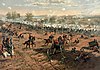
“According to old records, it has been a rule with the Muslim rulers from the first to build mosques, monasteries, and inns, spread Islam, and put (a stop to) non-Islamic practices, wherever they found prominence (of kufr). Accordingly, even as they cleared up Mathura, Bindraban etc., from the rubbish of non-Islamic practices, the Babari mosque was built up in AH 923 (?) under the patronage of Sayyid Musa Ashiqan in the Janmasthan temple (butkhane Janmsthan mein) in Faizabad Avadh, which was a great place of (worship) and capital of Rama's father'...‘Among the Hindus it was known as Sita ki Rasoi’ (p. 9-10)... 'A great mosque was built on the spot where Sita ki Rasoi is situated. During the regime of Babar, the Hindus had no guts to be a match for the Muslims. The mosque was built in AH 923 (?) under the patronage of Sayyid Mir Ashiqan' Aurangzeb built a mosque on the Hanuman Garhi' The Bairagis effaced the mosque and erected a temple in its place. Then idols began to be worshipped openly in the Babari mosque where the Sita ki Rasoi is situated.'”
“On Monday the 9th of the first Jumada, we got out of the suburbs of Agra, on our journey (safar) for the Holy War, and dismounted in the open country, where we remained three or four days to collect our army and be its rallying-point...On this occasion I received a secret inspiration and heard an infallible voice say: 'Is not the time yet come unto those who believe, that their hearts should humbly submit to the admonition of Allah, and that truth which hath been revealed? Thereupon we set ourselves to extirpate the things of wickedness...
Above all, adequate thanks cannot be rendered for a benefit than which none is greater in the world and nothing is more blessed, in the world to come, to wit, victory over most powerful infidels and dominion over wealthiest heretics, these are the unbelievers, the wicked.'In the eyes of the judicious, no blessing can be greater than this....Previous to the rising in Hindustan of the Sun of dominion and the emergence there of the light of the Shahansha's (i.e. Babur's) Khalifate the authority of that execrated pagan (Sanga) - at the Judgment Day he shall have no friend - was such that not one of all the exalted sovereigns of this wide realm, such as the Sultan of Delhi, the Sultan of Gujarat and the Sultan of Mandu, could cope with this evil-dispositioned one, without the help of other pagans...
Ten powerful chiefs, each the leader of a pagan host, uprose in rebellion, as smoke rises, and linked themselves, as though enchained, to that perverse one (Sanga); and this infidel decade who, unlike the blessed ten, uplifted misery-freighted standards which denounce unto them excruciating punishment, had many dependents, and troops, and wide-extended lands....The protagonists of the royal forces fell, like divine destiny, on that one-eyed Dajjal who to understanding men, shewed the truth of the saying, When Fate arrives, the eye becomes blind, and setting before their eyes the scripture which saith, whosoever striveth to promote the true religion, striveth for the good of his own soul, they acted on the precept to which obedience is due, Fight against infidels and hypocrites...
The pagan right wing made repeated and desperate attack on the left wing of the army of Islam, falling furiously on the holy warriors, possessors of salvation, but each time was made to turn back or, smitten with the arrows of victory, was made to descend into Hell, the house of perdition: they shall be thrown to bum therein, and an unhappy dwelling shall it be. Then the trusty amongst the nobles, Mumin Ataka and Rustam Turkman betook themselves to the rear of the host of darkened pagans...
At the moment when the holy warriors were heedlessly flinging away their lives, they heard a secret voice say, Be not dismayed, neither be grieved, for, if ye believe, ye shall be exalted above the unbelievers, and from the infallible Informer heard the joyful words, Assistance is from Allah, and a speedy victory! And do thou bear glad tiding to true believers. Then they fought with such delight that the plaudits of the saints of the Holy Assembly reached them and the angels from near the Throne, fluttered round their heads like moths.”

Babur Quotes by Topic
Find exactly what you are looking for by browsing this categorized list of Babur quotes by topic.
Babur on Decapitation 2 quotes
View all 2 quotes on Decapitation →Babur on Anti-Hindu sentiment
“God and Muhammad engaged you to extinguish the idolatry of the Indians.”

Babur on Taxation in India
“In many parts of the plains thorny jungles grow, behind the good defence of which the people… become stubbornly rebellious… and pay no taxes.”

Babur on Tax noncompliance
““In many parts of the plains thorny jungles grow, behind the good defence of which the people… become stubbornly rebellious… and pay no taxes.””

Babur on Hindu
“Most of the inhabitants of Hindustan are pagans ; they call a pagan a Hindu. Most Hindus believe in the transmigration of souls. All artisans, wage-earners, and officials are Hindus.”

Babur on Agra
“It was the hot-season when we came to Agra. All the inhabitants {khaldtq) had run away in terror. Neither grain for ourselves nor corn for our horses was to be had. The villages, out of hostility and hatred to us had taken to thieving and highway-robbery ; there was no moving on the roads.”

Babur on India
“[Hindustan] is a wonderful country. Compared with our countries it is a different world; its mountains, rivers, jungles and deserts, its towns, its cultivated lands, its animals and plants, its peoples and their tongues, its rains, and its winds, are all different. ...Once the water of Sind is crossed, everything is in the Hindustan way, land, water, tree, rock, people and horde, opinion and custom.”

Babur on Gwalior
“'Next day, at the time of the noon prayer, we went out for seeing those places in Gwalior which we had not yet seen' Going out of the Hathipole Gate of the fort, we arrived at a place called Urwa'...'Solid rocks surround Urwa on three sides' On these sides people have carved statues in stone. They are in all sizes, small and big. A very big statue, which is on the southern side, is perhaps 20 yards high. These statues are altogether naked and even their private parts are not covered'...'Urwa is not a bad place. It is an enclosed space. Its biggest blemish is its statues. I ordered that they should be destroyed.'”

Quotes About Babur
Gain deeper perspective through quotes about Babur from others.
Tariq Rahman - Interpretations of Jihad on Babur
“The rulers of India, whether Turks, Pathans, or Mughals, used Islamic vocabulary to legitimise their rule in the eyes of their Muslim chiefs and the ‘ulamā.... Ẓahīruddīn Bābar (1483–1530), the first ruler of the Mughal dynasty of India, in his memoir Bābar-Nāmah, also uses the vocabulary of jihad when he confronts the Hindu ruler Rānā Sangrām Singh (1484–1528), the ruler of Mewar, in the battle of Tarain but not when he defeats the Muslim ruler Ibrāhīm Lodhī (r. 1517–1526).”
His epitaph at Kabul. quoted on Babur
““A ruler from whose brow shone the Light of God was that Back-bone of the Faith (zahiru’d-dîn) Muhammad Babur Padshah. Together with majesty, dominion, fortune, rectitude, the open-hand and the firm Faith, he had share in prosperity, abundance and the triumph of victorious arms. He won the material world and became a moving light; for his every conquest he looked, as for Light, towards the world of souls. When Paradise became his dwelling and Ruzwãn asked me the date, I gave him for answer, “Paradise is forever Babur Padshah’s abode.””
Abu Fazl on Babur
“King of the four quarters, and of the seven heavens; celestial sovereign; diadem of the sublime throne; great of genius and great-ness-conferring; fortune-increaser; of excellent horoscope; heaven in comprehensiveness; earth in stability; lion-hearted; clime-capturer; lofty in splendour; of active brain; searcher after knowledge; rank-breaking lion rampant; exalter of dominion; ocean-hearted; of illustrious origin; a saintly sovereign; enthroned in the kingdom of reality and spirituality, Zahir-ud-din Muhammad Babar Padshah Ghazi. His pearl-like nature was a station for the marks of greatness and sublimity; freedom and detachment together with lofty restraint and majestic power flashed forth in his nature; in asceticism and absorption (faqr u fana) a Junid and Bãyazìd; while the magnificence and genius of an Alexander and of a Faridun shone from his brow.”
Justice Agarwal on Babur
“But if we consider what has been written in Babarnama by Babar in straight words without twisting or mincing them we find that like any other brave, courageous, tactful but brutal warrior, Babar also possess all these qualities. It is true that he was truly religious but it means that he was a complete Islamic person and lacked tolerance at least to the idol worshippers. He had no hitch in destroying idols worshipped by the inhabitants of India at that time and this we find very visibly... “However, the attempt by some of the authors to glorify or justify brutal massacre or action of some of the invaders or rulers even if they might have conquered the subcontinent, by providing justification, explanation etc. is not understandable for the reason that the things which are evident and straight cannot be clothed with a velvet cover and would not provide a shell to give it a different colour. It shall only mislead the public at large and in particular the students of history. In our view, the historical events must be placed straight without any distortion, without any addition of words and without providing any explanation or justification in the words of the author as the same would be nothing but a sheer conjecture and surmise. If we claim that Babar felt happy having seen the mound of human heads and still we tell somebody that he was a kind hearted religious man, had no love for violence it would be a blatant lie. This kind of attitude on the part of some of authors whose work has been placed before us for our consideration shows that these authors can go to the extent of glorification of any kind of misdeed which in the present day’s civilized society can never appreciate or swallow.” (para 1570)”
Babur Nama on Babur
“Babur... liberally distributed gold and gifts among his people. ... The first Mughal emperor Babur's bounty in this regard earned him the sobriquet of qalandar, that is, he gave away with both hands and was left with nothing for himself...."Valuable gifts (saughat) were sent for the various relations in Samarkand, Khurasan, Kashgar and Iraq." Details about these are given by Babur's daughter Gulbadan Begum... "To each Begum is to be delivered as follows: one special dancing girl of the dancing girls of sultan Ibrahim, with one gold plate full of jewels - ruby and pearl, cornelian and diamond, emerald and turquoise, topaz and cat's-eye - and two small mother-of-pearl trays full of asharfis, and two other trays of shahrukhis."”
Babur was exhorted by a noble of Kabul on Babur
“Go on then and possess yourself of the noblest country in the universe. Establish beyond the river Indus the Empire which your fathers have marked out for you. Go and fix your Court in the centre of Hindustan and prefer the delights of the Indies to the hoar and snow of Tartary. Everything seems to invite you to the south ; Providence has conducted you to Kabul and put you on the road to Hindustan ; God and Muhammad engaged you to extinguish the idolatry of the Indians.”
Guru Nanak on Babur 2 quotes
“Now that Babur’s authority has been established the princes starve. Thousands of pirs tried to stop Mir (Babur by means of magic) when they heard of his invasion. Resting-places were burnt, rock-like temples (were destroyed), princes were hacked into pieces and trampled in the dust. (In spite of the pirs’ efforts) no Mughal was blinded. None of the spells had any effect. Thou didst spare Khurdsan and spread fear in Hindustan. O Creator, (Thou didst this), but to avoid the blame Thou didst send the Mughal as (the messenger of) Death.”
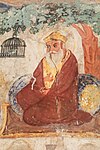
Guru Nanak quoted on Babur
RC Majumdar ed. on Babur
“Babur exempted Muslims from the payment of stamp duties which Hindus alone paid. His officers demolished Hindu temples and constructed mosques in their places at Sambhal,3 Chanderi and Ayodhya, and broke to pieces Jain idols at Urva near Gwalior. (306-7)”
Goel on Babur
“The scene shifted once mere to Delhi after Babur came out victorious against the Lodis and the Rajputs. The founder of the Mughal empire has received much acclaim from Pandit Jawaharlal Nehru for his fortitude in adversity, his daring against heavy odds, his swimming across many rivers, his love of flowers and fruits, and so on so forth. But his face, presented by himself in his Tuzuk-i-Bãburî, suffers irreparable damage if it is denuded of the rich hues of horrible cruelties in which he habitually indulged. The lurid details he provides of his repeated massacres of the infidels, leave no doubt that he was mighty proud of his performance. He was particularly fond of raising higher and higher towers of Hindu heads cut off during and after every battle he fought with them. He loved to sit in his royal tent to watch this spectacle. The prisoners were brought before him and butchered by his 'brave' swordsmen. On one occasion, the ground flowed with so much blood and became so full of quivering carcases that his tent had to be moved thrice to a higher level. He lost no opportunity of capturing prisoners of war and amassing plunder. In the dynasty founded by him it was incumbent upon every king that he should style himself a Ghazi, that is, slayer of infidels. When he broke vessels of wine on the eve of his battle with Rana Sangram Singh, he proclaimed that he would smash idols in a similar manner. And he destroyed temples wherever he saw them.”
Rizvi on Babur
“[Babur] is very liberal in citing appropriate verses from the Qur’ãn on the eve of his battle with Rãnã Sãñgã. In order to ensure his victory, he makes a covenant with Allãh by breaking the vessels containing wine as also the cups for drinking it, swearing at the same time that “he would break the idols of the idol-worshippers in a similar manner.” In the Fath-Nãma (prayer for victory) composed for him by Shykh Zain, Allah is described as “destroyer of idols from their foundations.” The language he uses for his Hindu adversaries is typically Islamic.”
Guru Granth Sahib on Babur
“Having subjugated Khuraasaan, Babar terrified Hindustaan So that blame does not come on Him, the Creator has sent the Mughal as the messenger of death So great was the slaughter, such the agony of the people, even then You felt no compassion, Lord? If some powerful man strikes another, one feels no grief But when a powerful tiger slaughters a flock of helpless sheep, its master must answer This jewel of a country has been laid waste and defiled by dogs, so much so that no one pays heed even to the dead… Guru Nanak proceeds to describe how the oppressors shaved off the maidens, their ‘heads with braided hair, with vermillion marks in the parting’; how ‘their throats were choked with dust’; how they were cast out of their palatial homes, unable now to sit even in the neighbourhood of their homes; how those who had come to the homes of their husbands in palanquins, decorated with ivory, who lived in the lap of luxury, had been tied with ropes around their necks; how their pearl strings had been shattered; how the very beauty that was their jewel had now become their enemy – ordered to dishonour them, the soldiers had carried them off. ‘Since Babar’s rule has been proclaimed,’ Guru Nanak wrote, ‘even the princes have no food to eat.’”

Koenraad Elst on Babur
“The fact that Hindu temple materials (14 black-stone sculptured pillars) have been used in the Babri Masjid is not an unusual feature requiring a special explanation; on the contrary, it was a fairly common practice meant as a visual display of the victory of Islam over infidelity. It was done in many mosques that have forcibly replaced temples, e.g. the Gyanvapi mosque in Varanasi (in which a part of the Kashi Vishvanath temple is still visible), the Adhai-Din-ka-Jhonpra mosque in Ajmer, the Quwwat-ul-Islam mosque in Delhi, or, outside India, the Jama Masjid of Damascus (which was a Christian cathedral)... There are Hindu temple materials in mosques attributed to Babar in Sambhal (replacing a Vishnu temple, and dated by archaeologists to the Sultanate period, just like the Ayodhya “Babri” Masjid) and Pilakhana. Local tradition affirms that the Babri Masjids in Palam, Sonipat, Rohtak, Panipat, and Sirsa have replaced Brahminical or Jain temples. The contemporary Tarikh-i-Babari describes how Babar’s troops “demolished many Hindu temples at Chanderi” when they occupied it.”

Sharma Sri Ram. on Babur
“Babur inherited his religious policy from the Lodis. Sikandar Lodi’s fanaticism must have been still remembered by some of the officials who continued to serve when Babur came into power. Babur was not a great administrator. He was content to govern India in the orthodox fashion. He projected no great changes in the government of the country except the design of a royal road from Agra to Kabul. But the Hindus, he met with, occupied no humble position. Rana Sanga, a Hindu, led a host wherein even Muslim armies were present under disaffected Pa than chiefs. It was Babur’s success at the battle of Khanava against Rana Sanga that enabled him to remain in India as her ruler. These two factors seem to have governed his religious policy. Babur, the born fighter against heavy odds, knew he was at a great crisis in his life on the eve of his battle against Rana Sanga. In order to conform strictly to the Muslim law he absolved Muslims from paying stamp duties thus confining the tax to Hindus alone. He thus not only continued, but increased, the distinction between his Hindu and Muslim subjects in the matter of their financial burdens. One of his officers, Hindu Beg, is said to have converted a Hindu temple at Sambhal into a mosque. His Sadr, Shaikh Zain, demolished many Hindu temples at Ghanderi when he occupied it. By Babur’s orders, Mir Baqi destroyed the temple at Ayudhya commemorating Rama’s birth place and built a mosque in its place in 1528-29. He destroyed Jain idols at Urva near Gwalior. There is no reason to believe that he did anything to relax the harshness of the religious policy which he found prevailing.”
Disputed Quotes
Quotes attributed to Babur that are questionable.
About Babur
Zahir-ud-Din Muhammad Babur or Babur (February 14, 1483 – December 26, 1530) was a descendant of Genghis Khan and Timur; Babur was a military adventurer, a soldier of distinction, a poet, diarist and statesman. Babur was the first Mughal Emperor and founder of the Mughal Empire.