Suppose you went to any scientist up to the late nineteenth century and told him: Here are two pieces of a substance called Uranium 235. If you hold them apart, nothing will happen. But if you bring them together suddenly, you will liberate as much energy as you could obtain from burning ten thousand tons of coal. No matter how farsighted and imaginative he might be, your pre-twentieth century scientist would have said: "What utter nonsense! That's magic, not science. Such things can't happen in the real world." Around 1890, when the foundations of physics and thermodynamics had (it seemed) been securely laid, he could have told you exactly why it was nonsense. … The wholly unexpected discovery of uranium fission in 1939 made possible such absurdly simple (in principle, if not in practice) devices as the atomic bomb and the nuclear chain reactor. No scientist could have predicted them; if he had, all his colleagues would have laughed at him.
What It Means
This is a placeholder explanation generated by the low-overhead model. It interprets "Suppose you went to any scientist up to the late nineteenth century and told him: Here are two pieces of a substance called Uranium 235. If you hold them apart, nothing will happen. But if you bring them together suddenly, you will liberate as much energy as you could obtain from burning ten thousand tons of coal. No matter how farsighted and imaginative he might be, your pre-twentieth century scientist would have said: "What utter nonsense! That's magic, not science. Such things can't happen in the real world." Around 1890, when the foundations of physics and thermodynamics had (it seemed) been securely laid, he could have told you exactly why it was nonsense. … The wholly unexpected discovery of uranium fission in 1939 made possible such absurdly simple (in principle, if not in practice) devices as the atomic bomb and the nuclear chain reactor. No scientist could have predicted them; if he had, all his colleagues would have laughed at him." in the context of "Arthur C. Clarke, in Profiles of the Future (Revised edition, 1973)" to mean that wisdom is timeless.
Tags
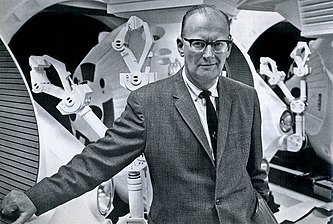
About Arthur C. Clarke