It was the ancient opinion of not a few in the earliest ages of philosophy, That the fixed stars stood immovable in the highest parts of the world; that under the Fixed Stars the Planets were carried about the Sun; that the Earth, as one of the Planets, described the annual course about the Sun, while a diurnal motion it was in the mean time revolved about its own axe; and that the Sun, as the common fire which served to warm the whole, was fixed in the center of the Universe. This was the philosophy taught of old by Philolaus, Aristarchus of Samos, Plato in his riper years, and the whole sect of the Pythagoreans. And this was the judgment of Anaximander, more ancient than any of them, and of that wise king of the Romans, Numa Pompilius; who, as a symbol of the figure of the World with the Sun in the center, erected a temple in honour of Vesta, of a round form, and ordained perpetual fire to be kept in the middle of it.
What It Means
This is a placeholder explanation generated by the low-overhead model. It interprets "It was the ancient opinion of not a few in the earliest ages of philosophy, That the fixed stars stood immovable in the highest parts of the world; that under the Fixed Stars the Planets were carried about the Sun; that the Earth, as one of the Planets, described the annual course about the Sun, while a diurnal motion it was in the mean time revolved about its own axe; and that the Sun, as the common fire which served to warm the whole, was fixed in the center of the Universe. This was the philosophy taught of old by Philolaus, Aristarchus of Samos, Plato in his riper years, and the whole sect of the Pythagoreans. And this was the judgment of Anaximander, more ancient than any of them, and of that wise king of the Romans, Numa Pompilius; who, as a symbol of the figure of the World with the Sun in the center, erected a temple in honour of Vesta, of a round form, and ordained perpetual fire to be kept in the middle of it." in the context of "Isaac Newton A Treatise of the System of the World (1728) pp. 1-2, attributed to Colin Maclaurin by L. Cohen, New System of Astronomy, Comprehending the Discovery of the Gravitating Power (1825) p.2" to mean that wisdom is timeless.

Tags
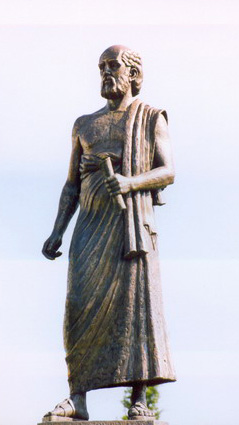
About Aristarchus of Samos