“
[W]e may assume [Anaxagoras] belonged to a family which had won distinction in the State. Nor need we reject the tradition that Anaxagoras neglected his possessions to follow science. ...[I]n the fourth century he was... regarded as the type of the man who leads the "theoretic life."
— Source
What It Means
This is a placeholder explanation generated by the low-overhead model. It interprets "[W]e may assume [Anaxagoras] belonged to a family which had won distinction in the State. Nor need we reject the tradition that Anaxagoras neglected his possessions to follow science. ...[I]n the fourth century he was... regarded as the type of the man who leads the "theoretic life."" in the context of "" to mean that wisdom is timeless.
Source:
The 'What it means' explanation text was generated by Google Gemini Flash (accessed January 18, 2026). https://gemini.google.com/app
Tags
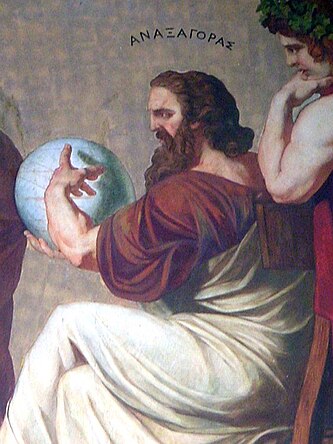
About Anaxagoras
Anaxagoras (c. 500 BC – 428 BC) was a Pre-Socratic Greek philosopher from Clazomenae in Asia Minor. He introduced the concept of Nous (Mind), as an ordering force in the cosmos. He regarded material substance as an infinite multitude of imperishable primary elements, referring all generation and disappearance to mixture and separation respectively.
View all quotes →