Bertrand Russell, in A History of Western Philosophy (1945), Book One, Part I, Chapter VIII, Anaxagoras, p. 62
“
Anaxagoras held that everything is infinitely divisible, and that even the smallest portion of matter contains some of each element. Things appear to be that of which they contain the most. Thus, for example, everything contains some fire, but we only call it fire if that element preponderates. He argues against the void, saying that the clepsydra or an inflated skin shows that there is air where there seems to be nothing.
— Bertrand Russell
What It Means
This is a placeholder explanation generated by the low-overhead model. It interprets "Anaxagoras held that everything is infinitely divisible, and that even the smallest portion of matter contains some of each element. Things appear to be that of which they contain the most. Thus, for example, everything contains some fire, but we only call it fire if that element preponderates. He argues against the void, saying that the clepsydra or an inflated skin shows that there is air where there seems to be nothing." in the context of "Bertrand Russell, in A History of Western Philosophy (1945), Book One, Part I, Chapter VIII, Anaxagoras, p. 62" to mean that wisdom is timeless.

Source: Wikiquote: "Anaxagoras" (Quotes about Anaxagoras)
The 'What it means' explanation text was generated by Google Gemini Flash (accessed January 18, 2026). https://gemini.google.com/app
Tags
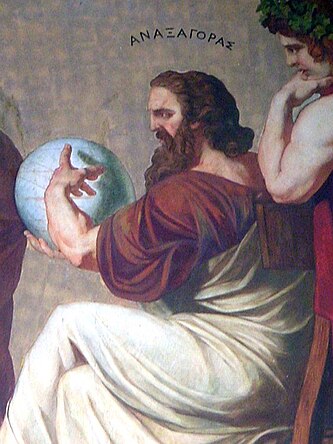
About Anaxagoras
Anaxagoras (c. 500 BC – 428 BC) was a Pre-Socratic Greek philosopher from Clazomenae in Asia Minor. He introduced the concept of Nous (Mind), as an ordering force in the cosmos. He regarded material substance as an infinite multitude of imperishable primary elements, referring all generation and disappearance to mixture and separation respectively.
View all quotes →