Link Copied!
Amiri Baraka Quotes (1934-2014)
Writer, Poet


About Amiri Baraka
Amiri Baraka (October 7, 1934 – January 9, 2014), previously known as LeRoi Jones and Imamu Amear Baraka, was an African-American writer of poetry, drama, fiction, essays and music criticism.
Best Amiri Baraka Quotes
Shortest
Earliest
Explore our curated collection of the most famous and impactful Amiri Baraka quotes.
“A man is either free or he is not. There cannot be any apprenticeship for freedom.”

“When I was saying, 'White people go to hell,' I never had trouble finding a publisher, but when I was saying, 'Black and white, unite and fight, destroy capitalism,' then you suddenly get to be unreasonable.”

“I guess I was the most unbohemian of all bohemians. My bohemianism consisted of not wanting to get involved with the stupid stuff that I thought people wanted you to get involved with — ... namely America...”
“You cannot stop struggling just because you’ve got a black guy walking around saying some stuff. Just because his skin is your color don’t mean his brain is the same as yours; if you’re going to bomb Libya you’re nuts. So it’s a continual struggle to raise the level of social consciousness in the country. Not only for black people but for everybody who needs that change.”

“One of the most persistent traits of the Western white man has always been his fanatical and almost instinctive assumption that his systems and ideas about the world are the most desirable, and further that people who do not aspire to to them, or at least think them admirable, are savages or enemies. The idea that Western thought might be exotic if viewed from another landscape never presents itself to most Westerners.”
“The Black Artist's role in America is to aid in the destruction of America as he knows it. His role is to report and reflect so precisely the nature of the society, and of himself, in that society, that other men will be moved by the exactness of his rendering, and if they are black men, grow strong through this moving, having seen their own strength, and weakness, and if they are white men, tremble, curse, and go mad, because they will be drenched with the filth of their evil.”
“So he gave me an Arab name; he gave me the name Amir Barakat. But I didn't want an Arab name ... [so] I took the name and Swahili-ized it and Bantu-ized it, and changed it from Amir to Amiri and from Barakat to Baraka to make it a Swahili name — the same kind of name you'd find in Tanzania or Uganda or Kenya. Now, of course I'm no longer in a cultural nationalist movement, but I'd be the only one in my family with an American name.”
“The poor Negro always remembered himself as an ex-slave and used this as the basis of any dealings with the mainstream of American society. The middle class black man bases his whole existence on the hopeless hypothesis that no one is supposed to remember that for almost three hundred years there was slavery in America, that the white man was a master, the black man a slave. This knowledge, however, is at the root of the legitimate black culture of this country. It is this knowledge, with its attendant muses of self-division, self-hatred, stoicism, and finally quixotic optimism, that informs the most meaningful of Afro-American music.”
Amiri Baraka Quotes by Topic
Find exactly what you are looking for by browsing this categorized list of Amiri Baraka quotes by topic.
Amiri Baraka on African-American art
“The Black Artist's role in America is to aid in the destruction of America as he knows it. His role is to report and reflect so precisely the nature of the society, and of himself, in that society, that other men will be moved by the exactness of his rendering, and if they are black men, grow strong through this moving, having seen their own strength, and weakness, and if they are white men, tremble, curse, and go mad, because they will be drenched with the filth of their evil.”

What Amiri Baraka Said About Others
Discover personal opinions Amiri Baraka shared regarding contemporaries.
Amiri Baraka on Fidel Castro
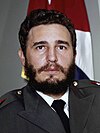
“At one point during the speech the crowd interrupted for about twenty minutes, crying, "Venceremos, venceremos, venceremos, venceremos, venceremos, venceremos, venceremos, venceremos." The entire crowd, 60 or 70,000 people, all chanting in unison. Fidel stepped away from the lectern, grinning, talking to his aides. He quieted the crowd with a wave of his arms and began again. At first softly, with the syllables drawn out and enunciated, then tightening his voice and going into an almost musical rearrangement of his speech. He condemned Eisenhower, Nixon, the South, the Platt Amendment, and Fulgencio Batista in one long, unbelievable sentence. The crowd interrupted again, "Fidel, Fidel, Fidel, Fidel, Fidel, Fidel, Fidel, Fidel, Fidel, Fidel, Fidel, Fidel." He leaned away from the lectern, grinning at the Chief of the Army. The speech lasted almost two and a half hours, being interrupted time and time again by the exultant crowd and once by five minutes of rain. When it began to rain, Almeida draped a rain jacket around Fidel's shoulders, and he relit his cigar. When the speech ended, the crowd went out of its head, roaring for almost forty-five minutes.”
Quotes About Amiri Baraka
Gain deeper perspective through quotes about Amiri Baraka from others.
Sandra María Esteves interview on Amiri Baraka
“(At National Black Theater performance) I was in awe of the words I witnessed that day. It was the first time that I heard the works of writers like Gwendolyn Brooks, Nikki Giovanni, Langston Hughes, Amiri Baraka. I heard poetry that was about me, that was very immediate. I connected to it in a visceral way. That experience moved me so profoundly that I went home and that night I wrote my first batch of poems. It was like the floodgates opened. That reading empowered me with a voice and gave me permission to express everything that had been festering in me for years. So I just started experimenting with language and writing all kinds of things.”
Ross Gay interview quoted on Amiri Baraka
Mark Kurlansky on Amiri Baraka
“LeRoi Jones was also one of the popular poets of the 1968 generation. His most famous line was fast becoming “Up against the wall motherfucker this is a stick-up.” A 1967 East Village “affinity group” named themselves “the Motherfuckers” after the Jones poem. An affinity group used intense intellectual debates as an underpinning for carrying out the kind of media-grabbing street theater that Abbie Hoffman could do so well. During the New York City garbage strike, the Motherfuckers hauled garbage by subway from the redolent mountains of it left on the sidewalks to the newly opened Lincoln Center.”

Cornel West on Amiri Baraka
“Imamu Amiri Baraka, a seminal man of letters, a revolutionary black nationalist, and a mesmerizing poet.”

About Amiri Baraka
Amiri Baraka (October 7, 1934 – January 9, 2014), previously known as LeRoi Jones and Imamu Amear Baraka, was an African-American writer of poetry, drama, fiction, essays and music criticism.