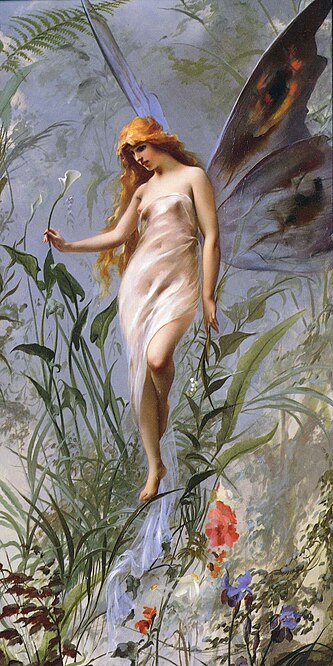
The pretty game of calling on the children of the audience of "Peter Pan" to declare their faith in fairies seemed to me disastrous—a game of men and women at the expense of children, a cumbersome frolic at best and an artificial, a tyrannous use of the adult sense of sentimental humour against the helpless. I could with better conscience use my superior physical strength upon them than exploit them for love of my own condescension. (And yet Sir J. Barrie has written the most adorable "pretending" story ever written about a child.)No, children love a fairy story not because they think it true, but because they think it untrue, and because it makes no fraudulent appeal to their excellent good sense. That sense they are delighted to put aside while they "pretend." That is their own word.[…] "Let's pretend," not "Let's believe." Their mother does not put "Let's pretend" into the child's mouth; she finds it there. Without it there is no play. But the pretending is always drama and never deception or self-deception.
What It Means
This is a placeholder explanation generated by the low-overhead model. It interprets "The pretty game of calling on the children of the audience of "Peter Pan" to declare their faith in fairies seemed to me disastrous—a game of men and women at the expense of children, a cumbersome frolic at best and an artificial, a tyrannous use of the adult sense of sentimental humour against the helpless. I could with better conscience use my superior physical strength upon them than exploit them for love of my own condescension. (And yet Sir J. Barrie has written the most adorable "pretending" story ever written about a child.)No, children love a fairy story not because they think it true, but because they think it untrue, and because it makes no fraudulent appeal to their excellent good sense. That sense they are delighted to put aside while they "pretend." That is their own word.[…] "Let's pretend," not "Let's believe." Their mother does not put "Let's pretend" into the child's mouth; she finds it there. Without it there is no play. But the pretending is always drama and never deception or self-deception." in the context of "Alice Meynell, Ch. V "Fairies", Childhood (London: B. T. Batsford, 1913), pp. 32–33." to mean that wisdom is timeless.

About Alice Meynell