On the question of the "origin of species" Mr. Haughton enlarges considerably; but his chief arguments are reduced to the setting-up of "three unwarrantable assumptions," which he imputes to the Lamarckians and Darwinians, and then, to use his own words, "brings to the ground like a child's house of cards." The first of these is "the indefinite variation of species continuously in the one direction." Now this is certainly never assumed by Mr. Darwin, whose argument is mainly grounded on the fact that variations occur in every direction. This is so obvious that it hardly needs insisting on. In every large family there is almost always one child taller, one darker, one thinner than the rest; one will have a larger nose, another a larger eye: they vary morally as well; some are more poetical, others more morose; one has a genius for numbers, another for painting. It is the same in animals: the puppies, or kittens, or rabbits of one litter differ in many ways from each other - in colour, in size, in disposition; so that, though they do not "vary continuously in one direction," they do vary continuously in many directions; and thus there is always material for natural selection to act upon in some direction that may be advantageous. [...] I will only, in conclusion, quote from it a short paragraph which contains an important truth, but which may very fairly be applied in other quarters than those for which the author intended it: - "No progress in natural science is possible as long as men will take their rude guesses at truth for facts, and substitute the fancies of their imagination for the sober rules of reasoning."
What It Means
This is a placeholder explanation generated by the low-overhead model. It interprets "On the question of the "origin of species" Mr. Haughton enlarges considerably; but his chief arguments are reduced to the setting-up of "three unwarrantable assumptions," which he imputes to the Lamarckians and Darwinians, and then, to use his own words, "brings to the ground like a child's house of cards." The first of these is "the indefinite variation of species continuously in the one direction." Now this is certainly never assumed by Mr. Darwin, whose argument is mainly grounded on the fact that variations occur in every direction. This is so obvious that it hardly needs insisting on. In every large family there is almost always one child taller, one darker, one thinner than the rest; one will have a larger nose, another a larger eye: they vary morally as well; some are more poetical, others more morose; one has a genius for numbers, another for painting. It is the same in animals: the puppies, or kittens, or rabbits of one litter differ in many ways from each other - in colour, in size, in disposition; so that, though they do not "vary continuously in one direction," they do vary continuously in many directions; and thus there is always material for natural selection to act upon in some direction that may be advantageous. [...] I will only, in conclusion, quote from it a short paragraph which contains an important truth, but which may very fairly be applied in other quarters than those for which the author intended it: - "No progress in natural science is possible as long as men will take their rude guesses at truth for facts, and substitute the fancies of their imagination for the sober rules of reasoning."" in the context of ""Remarks on the Rev. S. Haughton's Paper on the Bee's Cell, And on the Origin of Species" (1863)." to mean that wisdom is timeless.
Tags
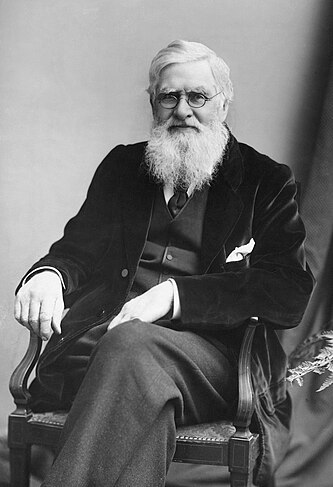
About Alfred Russel Wallace