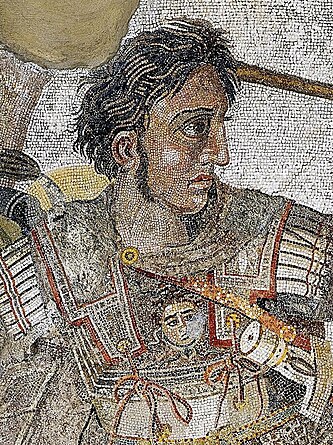
After fighting, scheming and murdering in pursuit of the secure tenure of absolute power, he found himself at last on a lonely pinnacle over an abyss, with no use for his power and security unattainable. His genius was such that he ended an epoch and began another - but one of unceasing war and misery, from which exhaustion produced an approach to order after two generations and peace at last under the Roman Empire. He himself never found peace. One is tempted to see him, in medieval terms, as the man who sold his soul to the Devil for power: the Devil kept his part of the bargain but ultimately claimed his own. But to the historian, prosaically such allegory, we must put it differently: to him, when he has done all the work - work that must be done, and done carefully - of analysing the play of faction and the system of government, Alexander illustrates with startling clarity the ultimate loneliness of supreme power.
What It Means
This is a placeholder explanation generated by the low-overhead model. It interprets "After fighting, scheming and murdering in pursuit of the secure tenure of absolute power, he found himself at last on a lonely pinnacle over an abyss, with no use for his power and security unattainable. His genius was such that he ended an epoch and began another - but one of unceasing war and misery, from which exhaustion produced an approach to order after two generations and peace at last under the Roman Empire. He himself never found peace. One is tempted to see him, in medieval terms, as the man who sold his soul to the Devil for power: the Devil kept his part of the bargain but ultimately claimed his own. But to the historian, prosaically such allegory, we must put it differently: to him, when he has done all the work - work that must be done, and done carefully - of analysing the play of faction and the system of government, Alexander illustrates with startling clarity the ultimate loneliness of supreme power." in the context of "Ernst Badian, Studies in Greek and Roman History, Alexander the Great and the Loneliness of Power, 1964 p. 204" to mean that wisdom is timeless.

Tags
About Alexander the Great