• No independent source for Solzhenitsyn's phrasing of Davis' response has been found, but he was probably referring to this open letter from Czech dissident Jiri Pelikan, which includes the following note at the bottom: The only response from Angela Davis to Jiri Pelikan's moving appeal that we are aware of was reported in the London Times where Mr. Pelikan's Open Letter had also appeared. According to The Times, Charlene Mitchell, a close friend of Angela Davis, who claimed that she spoke in her behalf, said that Angela Davis held the view that those who were jailed in Eastern Europe were trying to undermine their governments and that those who went into political exile were attacking their own countries and therefore undeserving of her support.
In our country, literally for an entire year, we heard nothing at all except Angela Davis. We had our ears stuffed with Angela Davis. Little children in school were told to sign petitions in defence of Angela Davis. Although she didn't have too difficult a time in this country's jails, she came to recuperate in Soviet resorts. Some Soviet dissidents–but more important, a group of Czech dissidents–addressed an appeal to her: 'Comrade Davis, you were in prison. You know how unpleasant it is to sit in prison, especially when you consider yourself innocent. You have such great authority now. Could you help our Czech prisoners? Could you stand up for those people in Czechoslovakia who are being persecuted by the state?' Angela Davis answered: 'They deserve what they get. Let them remain in prison.' That is the face of Communism. That is the heart of Communism for you.
What It Means
This is a placeholder explanation generated by the low-overhead model. It interprets "In our country, literally for an entire year, we heard nothing at all except Angela Davis. We had our ears stuffed with Angela Davis. Little children in school were told to sign petitions in defence of Angela Davis. Although she didn't have too difficult a time in this country's jails, she came to recuperate in Soviet resorts. Some Soviet dissidents–but more important, a group of Czech dissidents–addressed an appeal to her: 'Comrade Davis, you were in prison. You know how unpleasant it is to sit in prison, especially when you consider yourself innocent. You have such great authority now. Could you help our Czech prisoners? Could you stand up for those people in Czechoslovakia who are being persecuted by the state?' Angela Davis answered: 'They deserve what they get. Let them remain in prison.' That is the face of Communism. That is the heart of Communism for you." in the context of "Aleksandr Solzhenitsyn, Warning to the West (1986) (pp. 60-61).
• No independent source for Solzhenitsyn's phrasing of Davis' response has been found, but he was probably referring to this open letter from Czech dissident Jiri Pelikan, which includes the following note at the bottom: The only response from Angela Davis to Jiri Pelikan's moving appeal that we are aware of was reported in the London Times where Mr. Pelikan's Open Letter had also appeared. According to The Times, Charlene Mitchell, a close friend of Angela Davis, who claimed that she spoke in her behalf, said that Angela Davis held the view that those who were jailed in Eastern Europe were trying to undermine their governments and that those who went into political exile were attacking their own countries and therefore undeserving of her support." to mean that wisdom is timeless.

Tags
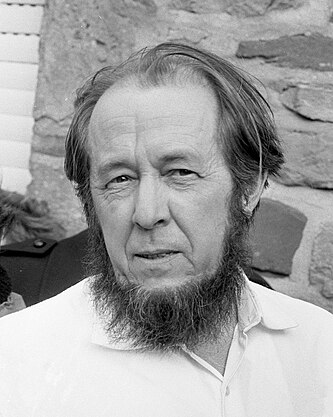
About Aleksandr Solzhenitsyn