• The wireless telegraph is not difficult to understand. The ordinary telegraph is like a very long cat. You pull the tail in New York, and it meows in Los Angeles. The wireless is the same, only without the cat.
• Variant, earliest known published version is How to Think Like Einstein by Scott Thorpe (2000), p. 61. Appeared on the internet before that, as in this archived page from 12 October 1999
You see, wire telegraph is a kind of a very, very long cat. You pull his tail in New York and his head is meowing in Los Angeles. Do you understand this? And radio operates exactly the same way: you send signals here, they receive them there. The only difference is that there is no cat.
What It Means
This is a placeholder explanation generated by the low-overhead model. It interprets "You see, wire telegraph is a kind of a very, very long cat. You pull his tail in New York and his head is meowing in Los Angeles. Do you understand this? And radio operates exactly the same way: you send signals here, they receive them there. The only difference is that there is no cat." in the context of "Earliest published version found on Google Books with this phrasing is in the 1993 book The Internet Companion: A Beginner's Guide to Global Networking by Tracy L. LaQuey and Jeanne C. Ryer, p. 25. However, the quote seems to have been circulating on the internet earlier than this, appearing for example in this post from 1987 and this one from 1985. No reference has been found that cites a source in Einstein's original writings, and the quote appears to be a variation of an old joke that dates at least as far back as 1866, as discussed in this entry from the "Quote Investigator" blog. A variant was told by Thomas Edison, appearing in The Diary and Sundry Observations of Thomas Alva Edison (1948), p. 216: "When I was a little boy, persistently trying to find out how the telegraph worked and why, the best explanation I ever got was from an old Scotch line repairer who said that if you had a dog like a dachshund long enough to reach from Edinburgh to London, if you pulled his tail in Edinburgh he would bark in London. I could understand that. But it was hard to get at what it was that went through the dog or over the wire." A variant of Edison's comment can be found in the 1910 book Edison, His Life and Inventions, Volume 1 by Frank Lewis Dyer and Thomas Commerford Martin, p. 53.
• The wireless telegraph is not difficult to understand. The ordinary telegraph is like a very long cat. You pull the tail in New York, and it meows in Los Angeles. The wireless is the same, only without the cat.
• Variant, earliest known published version is How to Think Like Einstein by Scott Thorpe (2000), p. 61. Appeared on the internet before that, as in this archived page from 12 October 1999" to mean that wisdom is timeless.
Tags
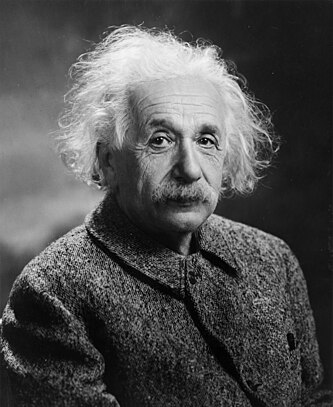
About Albert Einstein