The majority of the stupid is invincible and guaranteed for all time. The terror of their tyranny, however, is alleviated by their lack of consistency.
• Ideas and Opinions
• Ideas and Opinions
“
Die Majorität der Dummen ist unüberwindbar und für alle Zeiten gesichert. Der Schrecken ihrer Tyrannei ist indessen gemildert durch Mangel an Konsequenz.
— Albert Einstein
What It Means
This is a placeholder explanation generated by the low-overhead model. It interprets "Die Majorität der Dummen ist unüberwindbar und für alle Zeiten gesichert. Der Schrecken ihrer Tyrannei ist indessen gemildert durch Mangel an Konsequenz." in the context of "The majority of the stupid is invincible and guaranteed for all time. The terror of their tyranny, however, is alleviated by their lack of consistency.
• Ideas and Opinions" to mean that wisdom is timeless.
Source: Wikiquote: "Albert Einstein" (Quotes, 1950s, Essay to Leo Baeck (1953): Statements by Einstein from Essays Presented to Leo Baeck on the Occasion of His Eightieth Birthday (1954), p. 26; Baeck's birthday was 23 May 1953; Einstein Archives 28-962. Some quotes are from The New Quotable Einstein (2005) edited by Alice Calaprice, pp. 120-121, others from Ideas and Opinions by Albert Einstein (1954), where they appear in the section "Aphorisms for Leo Baeck.")
The 'What it means' explanation text was generated by Google Gemini Flash (accessed February 08, 2026). https://gemini.google.com/app
Tags
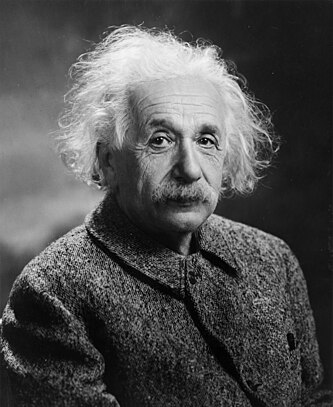
About Albert Einstein
Albert Einstein (14 March 1879 – 18 April 1955) was a Jewish German theoretical physicist, widely acknowledged to be one of the greatest physicists of all time. Einstein is known for developing the theory of relativity, but he also made important contributions to the development of the theory of quantum mechanics. Together, relativity and quantum mechanics are the two pillars of modern physics. He won the 1921 Nobel Prize in Physics for his explanation of the photoelectric effect.
View all quotes →