The earliest published source located on Google Books attributing this to Einstein is the 2000 book The Internet Handbook for Writers, Researchers, and Journalists by Mary McGuire, p. 14. It was attributed to him on the internet before that, as in this post from 1997. Variants of the quote can be found well before this however, as in the 1989 book Urban Surface Water Management by S. G. Walesh, which on p. 315 contains the statement (said to have been 'stated anonymously'): "The computer is incredibly fast, accurate, and stupid. Man is unbelievably slow, inaccurate, and brilliant. The marriage of the two is a challenge and opportunity beyond imagination." Even earlier, the article "A Paper Industry Application of Systems Engineering and Direct Digital Control" by H. D. Couture, Jr. and M. A. Keyes, which appears in the 1969 Advances in Instrumentation: Vol. 24, Part 4, has a statement on this page which uses phrasing similar to the supposed Einstein quote in describing computers and people: "Computers are incredibly fast, accurate, and stupid. On the other hand, a well trained operator as compared with a computer is incredibly slow, inaccurate and brilliant." Variants with slightly different wording can be found earlier than 1969, as in this April 1968 article. The earliest source located, and most likely the origin of this saying, is an article titled "Problems, Too, Have Problems" by John Pfeiffer, which appeared in the October 1961 issue of Fortune magazine. As quoted here, Pfeiffer's article contained the line "Man is a slow, sloppy, and brilliant thinker; computers are fast, accurate, and stupid."
“

Computers are incredibly fast, accurate and stupid; humans are incredibly slow, inaccurate and brilliant; together they are powerful beyond imagination.

— Albert Einstein

What It Means

This is a placeholder explanation generated by the low-overhead model. It interprets "Computers are incredibly fast, accurate and stupid; humans are incredibly slow, inaccurate and brilliant; together they are powerful beyond imagination." in the context of "The earliest published source located on Google Books attributing this to Einstein is the 2000 book The Internet Handbook for Writers, Researchers, and Journalists by Mary McGuire, p. 14. It was attributed to him on the internet before that, as in this post from 1997. Variants of the quote can be found well before this however, as in the 1989 book Urban Surface Water Management by S. G. Walesh, which on p. 315 contains the statement (said to have been 'stated anonymously'): "The computer is incredibly fast, accurate, and stupid. Man is unbelievably slow, inaccurate, and brilliant. The marriage of the two is a challenge and opportunity beyond imagination." Even earlier, the article "A Paper Industry Application of Systems Engineering and Direct Digital Control" by H. D. Couture, Jr. and M. A. Keyes, which appears in the 1969 Advances in Instrumentation: Vol. 24, Part 4, has a statement on this page which uses phrasing similar to the supposed Einstein quote in describing computers and people: "Computers are incredibly fast, accurate, and stupid. On the other hand, a well trained operator as compared with a computer is incredibly slow, inaccurate and brilliant." Variants with slightly different wording can be found earlier than 1969, as in this April 1968 article. The earliest source located, and most likely the origin of this saying, is an article titled "Problems, Too, Have Problems" by John Pfeiffer, which appeared in the October 1961 issue of Fortune magazine. As quoted here, Pfeiffer's article contained the line "Man is a slow, sloppy, and brilliant thinker; computers are fast, accurate, and stupid."" to mean that wisdom is timeless.

Source: Wikiquote: "Albert Einstein" (Misattributed: Misattributed quotations for Einstein are very common.Dickinson, Kevin (2024-10-28), Einstein didn’t say that: How viral misquotes evolve and replicate, publisher: Big Think, retrieved: 2024-11-02) The 'What it means' explanation text was generated by Google Gemini Flash (accessed February 08, 2026). https://gemini.google.com/app
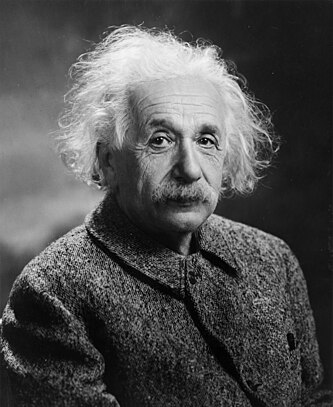
Albert Einstein

About Albert Einstein

Albert Einstein (14 March 1879 – 18 April 1955) was a Jewish German theoretical physicist, widely acknowledged to be one of the greatest physicists of all time. Einstein is known for developing the theory of relativity, but he also made important contributions to the development of the theory of quantum mechanics. Together, relativity and quantum mechanics are the two pillars of modern physics. He won the 1921 Nobel Prize in Physics for his explanation of the photoelectric effect.