Link Copied!
Albert Caraco Quotes (1919-1971)
Philosopher, Writer, Poet
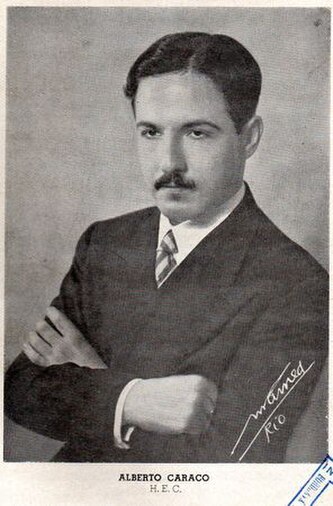
About Albert Caraco
Albert Caraco (8 July 1919 – 7 September 1971) was a French-Uruguayan philosopher, writer, essayist and poet of Turkish Jewish descent. He is best known for his two major works, Post Mortem (1968) and posthumously published Bréviaire du chaos (1982). He is often compared to the philosophers and writers such as Emil Cioran, Louis-Ferdinand Céline, Nicolás Gómez Dávila and Friedrich Nietzsche.
Best Albert Caraco Quotes
Shortest
Earliest
Explore our curated collection of the most famous and impactful Albert Caraco quotes.
“I am a racist and a colonialist.”

“Who are the most wicked of men? It's the optimists.”


“I was born to myself between 1946 and 1948, I then opened my eyes on the world, until that moment I have been blind.”
“I spent the first ten years of my life in Germany, the following ten in Paris, the following ten between Argentine and Uruguay.”
“Evil desires men to multiply, for the more men there are, the less they are worth. To be truly human, man will never be rare enough.”

“Happiness rarely leads us to intellectual adventures. Writers and artists, not to mention philosophers, are usually dissatisfied with themselves or the world.”

“Death is not terrible, life is terrible, but we see things literally and figuratively upside down. The philosopher is the one who puts everything back in its proper place.”
“For me, nothingness has a charm that the abortions that populate this place could never have and never will have. I thank heaven that I live here; leaving this world doesn't take any effort.”


“The older I grow, the more Gnosis speaks to my reason: the world is not ruled by a Providence, it's intrinsically evil and deeply absurd, and Creation is either the dream of blind intelligence or the game of a principle without a moral.”

“We live for death, love for death, and give birth and toil for death. Our works and days now follow one another in the shadow of death. The discipline we adhere to, the values we uphold, and the plans we make all lead to one end: death.”

“The fact that we suffer doesn't necessarily imply that pain is meaningful; quite the contrary! It's always pointless to endure pain, but our vanity refuses to admit it, and therefore builds castles in the air to amuse itself with illusions, which is also called metaphysics.”

“If I had to live my life over again, I wouldn't change a thing. I fully approve of what I've done, and I'm immensely proud of myself. It's life itself that I despise, not my existence; it's the principle, not its application, that couldn't have been better, given the circumstances.”
“Our most terrifying fears and our innermost secret desires for extermination are reflected in this elegant and profound book, without any sort of leniency to attenuate the disgust and hopelessness we feel when faced with a humanity constantly atrophied by a series of values and practices that lead to chaos.”
“We, who are not satisfied with empty words, consent to disappear, and we rejoice in our fate. We didn't choose to be born, and consider ourselves fortunate to have nowhere to outlive this life, which was imposed upon us rather than given — a life full of sorrows and pains with dubious or harmful pleasures.”
“We strive towards death like an arrow towards its target, and we never miss. Death is our only certainty, and we always know that we will die, no matter where, when, or how. The idea of eternal life is nonsense, eternity is not life, death is the rest we seek, life and death are intertwined, and those who demand something else ask for the impossible and will earn nothing but smoke.”
About Albert Caraco
Albert Caraco (8 July 1919 – 7 September 1971) was a French-Uruguayan philosopher, writer, essayist and poet of Turkish Jewish descent. He is best known for his two major works, Post Mortem (1968) and posthumously published Bréviaire du chaos (1982). He is often compared to the philosophers and writers such as Emil Cioran, Louis-Ferdinand Céline, Nicolás Gómez Dávila and Friedrich Nietzsche.