Fragment 250 (trans. by Plumptre), reported in Bartlett's Familiar Quotations, 10th ed. (1919)
“
O Death the Healer, scorn thou not, I pray,
To come to me: of cureless ills thou art
The one physician. Pain lays not its touch
Upon a corpse.
— Aeschylus
What It Means
This is a placeholder explanation generated by the low-overhead model. It interprets "O Death the Healer, scorn thou not, I pray,
To come to me: of cureless ills thou art
The one physician. Pain lays not its touch
Upon a corpse." in the context of "Fragment 250 (trans. by Plumptre), reported in Bartlett's Familiar Quotations, 10th ed. (1919)" to mean that wisdom is timeless.

Source: Wikiquote: "Aeschylus" (Quotes)
The 'What it means' explanation text was generated by Google Gemini Flash (accessed January 18, 2026). https://gemini.google.com/app
About Aeschylus
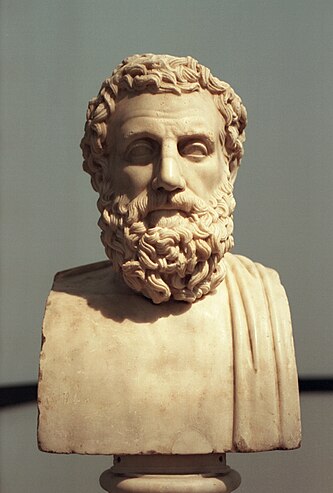
Aeschylus (Greek: Αἰσχύλος; 525 BC – 456 BC) was a playwright of ancient Greece, the earliest of the three greatest Greek tragedians, the others being Sophocles and Euripides.
About Aeschylus
Aeschylus (Greek: Αἰσχύλος; 525 BC – 456 BC) was a playwright of ancient Greece, the earliest of the three greatest Greek tragedians, the others being Sophocles and Euripides.
View all quotes →