Link Copied!
Abdullah of Saudi Arabia Quotes (1924-2015)
King
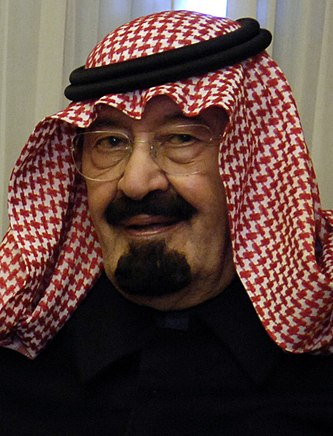
About Abdullah of Saudi Arabia
Abdullah bin Abd al-Aziz Al Saud (1 August 1924 – 23 January 2015) was the king of Saudi Arabia, having succeeded his brother Fahd bin Abdul Aziz on 1 August 2005.
Best Abdullah of Saudi Arabia Quotes
Shortest
Earliest
Explore our curated collection of the most famous and impactful Abdullah of Saudi Arabia quotes.

“We state with a unified voice that religions through which Almighty God sought to bring happiness to mankind should not be turned into instruments to cause misery,”

“Fanaticism and extremism cannot grow on an earth whose soil is embedded in the spirit of tolerance, moderation, and balance. Good governance can eliminate injustice, destitution and poverty.”

“In beloved Iraq, blood is flowing between brothers, in the shadow of an illegitimate foreign occupation, and abhorrent sectarianism threatens a civil war.”
“Allah says [in the Koran] : "If they repent before you overcome them, you should know that Allah is forgiving and merciful." ... we are opening the door of forgiveness[...] and acceptance of Islamic law, to all who have strayed and committed a crime in the name of religion...Everyone who belongs to this group that has wronged itself who has not yet been apprehended in terrorist operations – we offer them a chance to return to Allah...Anyone who accepts this and surrenders of his own free will...will be treated according to the law of Allah.”

Quotes About Abdullah of Saudi Arabia
Gain deeper perspective through quotes about Abdullah of Saudi Arabia from others.
George W. Bush on Abdullah of Saudi Arabia 2 quotes
“The crown prince is a modest, gentle, almost shy man. He speaks softly, doesn't drink alcohol, and prays five times a day. In eight years, I never saw him without his traditional robes.”

Muammar Gaddafi at the Doha Summit on Abdullah of Saudi Arabia
“For six years you have been running away, fearing confrontation. Let me assure you that you shouldn’t be afraid. After six years, it has become clear that the lie is behind you and the grave stands before you. You were created by Britain, and you are protected by America.”
Kim Ghattas on Abdullah of Saudi Arabia
“With the killing of Hariri, Iran had unofficially declared war on Saudi Arabia, just as the kingdom itself was feeling fragile, grappling with the wave of al-Qaeda bombings. In August 2005, King Fahd died and Crown Prince Abdallah, de facto ruler for a decade, became king. Despite the proxy war unfolding in Iraq and the killing of his protégé in Lebanon, King Abdallah tried to uphold the détente with Iran. He even hosted Ahmadinejad in Saudi Arabia a few times. But Iran was getting increasingly bolder in Iraq: the Islamic Revolutionary Guard Corps (IRGC) was funding and arming militias, evading US sanctions by siphoning off Iraqi oil, and planting their friends in key positions in ministries. King Abdallah then felt deeply betrayed when it was revealed that Iran had a secret nuclear program, one it had developed during the period of détente with Saudi Arabia. In 2008, after a political tussle in Lebanon about Hezbollah’s growing power, there was a showdown in the heart of Beirut between Hezbollah and Sunni militiamen. Everyone still had guns in Lebanon, but no one had a trained fighting force like Hezbollah. Within hours, hundreds of its fighters took over large parts of the city and routed their opponents. The political balance of the country had been tilted in favor of Iran and Syria. King Abdallah would soon begin to rail against Iran and call on the United States “to cut off the head of the snake.””
Massimo Introvigne on Abdullah of Saudi Arabia
“[Religious leader Abdullah] Hashem and his followers referred to an old prophecy that they applied to the death of King Abdullah of Saudi Arabia. This prophecy, which circulated widely amongst the Shiites, indicated that the Imam al-Mahdi should appear after the death of a King of Hejaz (i.e., Saudi Arabia) called Abdullah, identified by certain signs. According to Shia sources, Prophet Muhammad prophesied that “Hejaz will be ruled by a man whose name is the name of an animal, if you see him from far, you will think he is cross-eyed, and if you come close to him, you do not see anything (wrong) in his eyes. He will be succeeded by a brother of his, named Abdullah… Whoever guarantees for me the death of Abdullah, I guarantee for him the Riser/Qaim.” The AROPL notes that King Fahd of Saudi Arabia had the name of an animal (Fahd meaning “leopard”) and had the eye problem described in the prophecy. He died in 2005 and was succeeded by his brother Abdullah, who died in turn on January 23, 2015. Abdullah Hashem advanced his claims immediately after this event.”

David Wallechinsky on Abdullah of Saudi Arabia
“The case of Saudi Arabia highlights the difficulties that democracies face in trying to support freedom, human rights, and democracy. King Abdullah heads a royal family that completely controls Saudi society. Thanks to the fact that they own the world's largest reserves of oil, they are virtually immune from international criticism and they do not bother to hold even fake national elections. By law, all Saudi citizens must be Muslims. It is illegal for Saudis to follow a different religion. A Saudi woman cannot appear in public with a man who is not a relative. Women are required to completely cover their bodies in public and they must wear veils. Some Saudi women have expressed satisfaction with the restrictions in the country. However, the strict suppression of women is not voluntary, and Saudi women who would like to live a freer life are not allowed to do so. King Abdullah and his relatives follow an intolerant version of Islam known in the West as Wahhabism. Since 1975, the Saudi royal family has spent more than $70 billion financing mosques and Islamic centers worldwide, including more than $300 million in the United States, where most Muslims studying in Arabic use Saudi textbooks, some of which are virulently anti-Christian and anti-Jewish. If Saudi Arabia did not control so much oil, King Abdullah and the Saudi royal family would be treated just as much as pariahs as are Than Shwe and the Burmese generals.”
About Abdullah of Saudi Arabia
Abdullah bin Abd al-Aziz Al Saud (1 August 1924 – 23 January 2015) was the king of Saudi Arabia, having succeeded his brother Fahd bin Abdul Aziz on 1 August 2005.